Shock: Fracking Used to Inject Nuclear Waste Underground for Decades
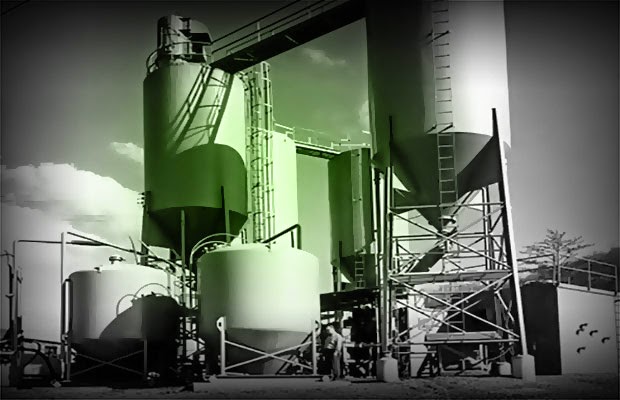
Unearthed articles from the 1960s detail how nuclear waste was buried beneath the Earth’s surface by Halliburton & Co. for decades as a means of disposing the by-products of post-World War II atomic energy production.
Fracking is already a controversial practice on its face; allowing U.S. industries to inject slurries of toxic, potentially carcinogenic compounds deep beneath the planet’s surface — as a means of “see no evil” waste disposal — already sounds ridiculous, dangerous, and stupid anyway without even going into further detail.
Alleged fracking links to the contamination of the public water supply and critical aquifers, as well as ties to earthquake upticks near drilling locations that are otherwise not prone to seismic activity have created uproar in the years since the 2005 “Cheney loophole,” which allowed the industry to circumvent the Safe Drinking Water Act by exempting fracking fluids, thus fast tracking shale fracking as a source of cheap natural gas.
Now, it is apparent that the fracking
industry is also privy to many secrets of the nuclear energy industry
and, specifically, where the bodies are buried, err… dangerous nuclear
waste is buried, rather — waste that atomic researchers have otherwise
found so difficult to eliminate.
TruthstreamMedia.com uncovered
several published newspaper accounts from the Spring of 1964 concerning
a then-newly disclosed plan to dump nuclear waste produced by the atomic
energy industry into hydraulic fracturing (fracking) wells using a
cement slurry technique developed by Halliburton & Co. The top two
fracking companies in the nation at the time were Halliburton and
Dowell, a subsidiary of Dow Chemical.
And here we thought fracking was a relatively new industrial phenomenon growing in popularity over just the last couple of decades. Boy were we wrong. Revealed within these articles is Halliburton’s long-standing relationship with the secret government and deep ties between the oil and nuclear industries.
Teaming up with the U.S. Government and Union Carbide Corp., who operate nuclear materials divisions at the Oak Ridge National Laboratories in Tennessee, Halliburton was then credited with “solving” the radioactive waste problem faced by America’s secretive nuclear industry. Dumping waste via fracking had apparently been going on since 1960, according to the reports, but was only made public here in 1964.
Out of Sight, Out of Mind
Each of the articles Truthstream found carries the same account under different headlines, with four of them using identical copy; and the fifth, published in the San Antonio Express, slightly rewritten based upon the same source information. The photo captions of each story also add some useful tidbits:
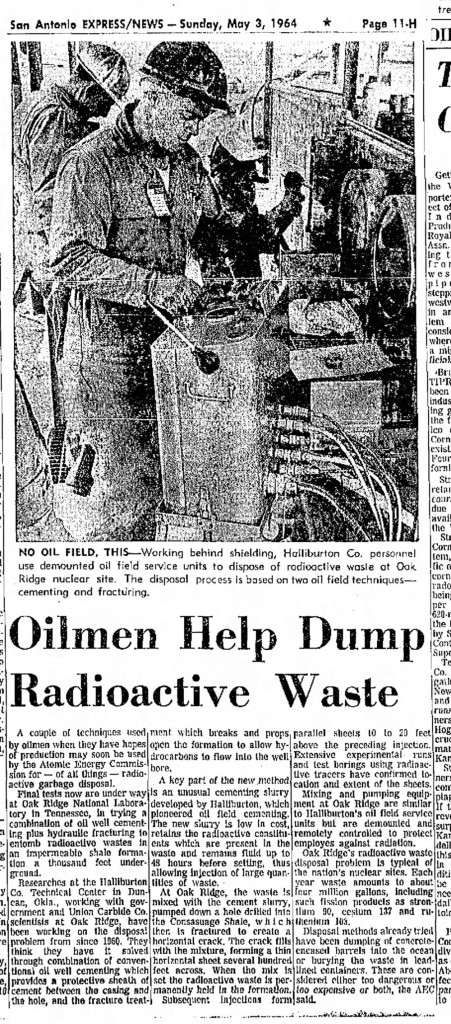 |
| May 3, 1964 edition of the San Antonio Express News. |
These ran in the:
April 19, 1964 edition of the Great Bend Tribune,
the April 22, 1964 edition of the Warren Times-Mirror,
the April 26, 1964 edition of the Lubbock Avalanche Journal,
the May 3, 1964 edition of the San Antonio Express News (original)
and the June 15, 1964 edition of the Denton Record Chronicle.
The story read, in part:
The method used at Oak Ridge begins by mixing the waste with a cement slurry, pumping the mixture down a hole drilled into the Conasuaga shale and then fracturing the shale to create a horizontal crack. The crack fills with the mixture to form a thin, horizontal sheet several hundred feet across. The mix sets to permanently hold the radioactive waste in the formation.
Union Carbide Corp., which operates facilities at Oak Ridge for the U.S. Atomic Energy Commission, and Halliburton, which provides specialized oil field services such as cementing fracturing worldwide, have collaborated on the project since 1960.
The mix remained liquid for 48 hours before it was supposed to permanently set and remain there, entombed, forever.
The articles make clear that the Atomic Energy Commission was preparing to use fracking as a means of disposing of nuclear wastes at additional facilities, with Oak Ridge being simply one of the largest, and the first to publicly disclose these out-of-sight disposal procedures:
Unfortunately, the ocean has been used as a giant trashcan not only by the nuclear industry, but municipal garbage and landfill companies and many other entities as well, without any real concern about its significant effects on the food supply and larger ecosystem of the planet.
The slightly different version in the San Antonio Express News added these details:

Meanwhile, the Great Bend Tribune added information about the Halliburton executives involved in the plan in their caption for a photo which shows businessmen looking at a diagram explaining how nuclear waste like strontium 90 is mixed with cement and injected into shale formations:
The process includes remote controlled operation of the hydraulic fracturing drill in order to shield workers from the “medium level” radioactive substances being dumped into the Earth’s crust, as the Warren Times Mirror in Pennsylvania notes in the caption:
How often this procedure has been used at other facilities since then is not entirely clear, though we know from reports discussed below that the practice continued and there is no indication that it ever stopped.
Five years later, the October 22, 1969 edition of the San Bernardino County Sun carried a report titled, “3 Ways to Manage Radioactive Waste.”
It discussed the ongoing and growing problems with nuclear waste, naming three principle strategies for managing the toxic stuff, summed up as “(1) delay and decay, (2) concentrate and confine and (3) dilute and disperse,” discussing how materials with lower half lives can supposedly be safely sequestered and later dumped, while other materials can be simply diluted and poured into existing groundwater supplies and systems.
 The UPI story
originating out of Oak Ridge states, in part,
The UPI story
originating out of Oak Ridge states, in part,
Oak Ridge proclaims that it found a solution to dealing with high level nuclear wastes, which has thus far been to keep it,
Note, this article cites a shallower depth, at levels as shallow as 500 feet, after the 1964 articles claimed a further removed depth of 1,000 feet to 5,000. The even “higher level wastes” were disposed of in abandoned salt mines, according to Oak Ridge.
Nuclear Waste ‘Safely Flushed Away’ into the Water Supply
The 1969 article states that “low level waste” is “material which can safely be flushed away into rivers and lakes or released into the atmosphere because the level of radioactivity is so low that is presents no hazard when diluted and flushed into man’s natural environment. The more difficult problem is involved in the high level, liquid and solid wastes which are produced in the reprocessing of used fuel elements from nuclear reactor cores.”
The idea that the waste dumped into water supplies was so “low level” as to be completely harmless is likely dubious and hopeful at best. Fluoride, a by-product of the nuclear power industry, was one of those constituents, and was transformed from being known as a rat poison to being known as a dental benefit by the original spin doctor and propagandist, Edward Bernays.
In his book The Fluoride Deception, author Christopher Bryson revealed how the nuclear industry also used fluoridation of the public water supply as a means of secretly dumping industrial waste after fluoride was a major by-product in the uranium enrichment process for building the atomic bomb. Bryson told Democracy Now:
More recently, an Associated Press investigation found in 2011 that 48 of 65 nuclear sites in the United States were leaking tritium, a radioactive form of hydrogen, into groundwater supplies via corroded pipes and tunnels. AP found at least 37 locations were in direct violation of federal drinking water standards for tritium, in some cases hundreds of times over.
Fracking Nuclear Waste ‘Safe for Millions of Years’… Unless It Leaks
Some 30 trillion gallons of toxic waste has been kept out of sight, out of mind by U.S. industries that have injected it hundreds and thousands of feet underground into wells since the 1960s.
Scientists who work for these corporations have used computer modeling to assure the Environmental Protection Agency that this waste poses no threat to our aquifers and that layers of rock deep within the Earth would safely store this stuff like Tupperware for millennia.
Already, several incidents have proven that scientific computer models are no match for reality.
It is clear from a December 21, 1973 article that disposal of nuclear waste via fracking continued, along with promises that it would be safe for millions of years to come.
The Dixon Evening Telegraph wrote in “Geologists look at energy crunch”:
That is, as the article points out, unless there are leaks.
As we found in research, leakage is exactly what has happened time and again throughout the years, including at disposal sites for Oak Ridge National Laboratories, according to reports in the following cases. Via ProPublica:
In 1975 in Beaumont, Texas, dioxin and a highly acidic herbicide injected underground by theVelsicol Chemical Corp. burned a hole through its well casing, sending as much as five million gallons of the waste into a nearby drinking water aquifer.
And these are hardly the only examples… in fact, it is just scratching the surface of an issue that is almost as incomprehensible as it is unfathomable.
Bingo…
There it is. The infallible, permanent, and “impermeable” deep injection wells that Halliburton and the Atomic Energy Commission considered as a solution to nuclear waste for eons to come were found turning up radioactive nuclear waste at the very Oak Ridge site where these 1960s disposal projects were taking place.
Subterranean Waste Disposal a ‘Cornerstone of the Nation’s Economy’
Those cemented wells, filled with injected disposal substances may be safely secured for a few years or even decades, but that is no guarantee for the years down the road and its certainly not the millennia as promised by Halliburton and others in the industry. In fact, many of the wells have been forgotten, abandoned, and are lost to the record books.
As ProPublica reports:
And many of these are injection wells, where all kinds of unwanted, toxic substances are dumped in order to be forgotten… though not necessarily gone.
Not only are these practices taking place, they are widespread… and widely defended, even with the known failures and safety issues.
Sure, maybe it’s better than dumping it directly into the waterways, but still. This isn’t just playing with fire, this is playing with the lives of everyone in the nation for generations to come.
Please read ProPublica’s full series of reports on this, starting here. Things have to change.
These people should not have started messing with something they did not know how to fully and safely manage.
How long can this madness continue until it winds up tainting every drinking glass in America?
Engineer Mario Salazar, who worked as a technical expert for 25 years with the EPA’s underground injection program in Washington, told ProPublica’s Abrahm Lustgarten something that should give us all pause about how radioactive nuclear waste and industrial pollutants in general are being handled, and where they may ultimately end up:
In 10 to 100 years we are going to find out that most of our groundwater is polluted. A lot of people are going to get sick, and a lot of people may die.
Aaron and Melissa created TruthstreamMedia.com, where this article first appeared, as an outlet to examine the news, place it in a broader context, uncover the deceptions, pierce through the fabric of illusions, grasp the underlying factors, know the real enemy, unshackle from the system, and begin to imagine the path towards taking back our lives, one step at a time, so that one day we might truly be free…
Copyright All rights reserved
http://www.healthfreedoms.org/shock-fracking-used-to-inject-nuclear-waste-underground-for-decades/