Solar eclipse will offer insight into the future of the grid
The upcoming solar eclipse will provide a problem, and plenty of insight, for solar energy demand response in Europe. The solar eclipse will last approximately two hours on March 20, and power station operators are preparing for the outage.
 |
|
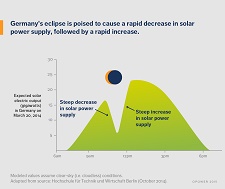
Expected solar electric output in Germany on March 20. All figures assume a clear sky. Credit: Opower. |
Although grid stability during the eclipse is the number one concern for utilities, the eclipse is also offering an opportunity for researchers to watch what happens to a power system run by a percentage of solar. Opower is looking at the effects of the eclipse on the European Power grid, and specifically how it will affect Germany -- a country that receives 7 percent of its electricity from 1.4 million solar energy systems.
"Germany's reliance on solar energy is, by international standards, astronomical," explained Opower researcher Barry Fisher. "Although the country is no bigger than the state of Montana, it boasts more than a quarter of all the solar electric capacity installed on earth. In the US, solar provides about 0.5 percent. During the sunniest hours of the year, photovoltaic (PV) systems have satisfied up to half of Germany's power demand."
Opower looked at an October 2014 solar eclipse in the United States and how the grid was affected by the loss of sunlight during that event. During that eclipse, the moon blocked 30 to 50 percent of the sun for nearly three hours. The Opower study found that during that period, 1,000 MW was taken out of the power supply. Solar customers were not only using less electricity, but they also exported 41 percent less excess power back to the grid.
The study also found that during the 2014 eclipse there was a large amount of thermal ("likely gas-fired," according to Opower) electricity generation dispatched.
Germany currently has more than double the amount of solar electricity capacity than the United States (38.5 GW vs. 17.5 GW).
"Still, areas with heavy solar penetration in the U.S. are susceptible to a solar eclipse having a substantial impact on the power grid," Fischer explained. "Opower's data analysis from 5,000 rooftop solar customers in the western region reveals that last October during a partial eclipse, solar homes sent 41 percent less electricity to the grid than usual. Generation from utility-scale solar power plants also declined steeply."
The systems operators balancing for the March 20 eclipse have a big job. According to Fischer, "The electric system relies on exact second-by-second balancing of demand and supply." Because of this, any decreases in solar power must be "compensated" within the system to prevent grid instability or blackouts.
On top of the stress put on the system during the eclipse, the power operators also have to worry about what happens when the sun reappears. Solar production is expected to fall 2.7 times faster than it normally does during the upcoming eclipse, and "the effect is similar to turning off a medium-sized power plant in Germany every minute -- for a full hour." As the moon moves across the sun and out of its path, solar power could return at a rate of 3.5 faster than normal.
"When the eclipse hits and solar power supply starts to tumble, German energy providers and grid operators can respond with a combination of strategies -- such as releasing energy stored behind hydroelectric dams, turning on quick-start natural gas power plants, or importing electricity from neighboring countries," Fischer said, adding that utilities will likely also utilize other complementary tactics, like encouraging their customers to delay using electricity during the eclipse.
The March 20 eclipse will be full of insight for future eclipses, and other events where the grid -- or a portion of the grid -- goes down.
"The upcoming eclipse over Germany's solar panels provides a sneak peek at a fascinating challenge facing tomorrow's electric grid: how can utilities and grid operators achieve the large-scale flexibility required to embrace an energy resource that, by its nature, rapidly turns on and off -- whether predictably due to eclipses and sunrises and sunsets, or unpredictably due to clouds and weather?" Fischer asked. "The challenge Germany confronts on March 20 may actually become a daily occurrence within 15 years according to one of the country's largest electric transmission operators. Assuming the German government achieves its target of 66 gigawatts (GW) of solar capacity, a clear-sky sunrise in 2030 could drive an increase in solar power supply as steep as the rebound phase of 2015's eclipse."
The European eclipse will be a good test for an expanding world of solar power, and by the time the multi-hour eclipses hit the United States in 2017, 2023 and 2024, the country should be prepared.
Fischer added, "As the electricity produced by renewables like solar and wind continues to grow, the grid will inevitably see larger swings in power production. That's why flexibility measures like fast-ramping power plants, adjustments to customer energy behavior, dynamic power pricing, energy storage, and a range of other strategies represent a critical dimension of the power grid's evolution to meet the needs of the 21st century."
For more:
- read the
study
© 2015 FierceMarkets, a division of Questex Media Group LLC. All rights reserved.
http://www.fierceenergy.com/story/solar-eclipse-will-offer-insight-future-grid/2015-03-13