When The Skies Turned To Black
The Locust Plaque of 1875
A study of the intersection of history and genealogy
Ever wonder why your ancestors suddenly left an area and moved to a
distant region? Or, why did they return to the same area that they
originally came from? If you had family who lived in the States of
Kansas, Nebraska, or the western portions of Iowa, Missouri, or
Minnesota in the mid 1870’s, chances are they were witnesses of the
devastating plagues of locusts that swept over the region. Lush gardens
and fields of a wide range of crops were reduced to a barren, desert
like appearance within a matter of hours. Crops that were needed to
sustain a family and their farm animals were destroyed leaving no means
of support during the coming winter.
As early as records are available, the central region of the United
States has had occasional times when locusts would increase in number
and quickly devour crops over a large region. None of the previous
invasions were nearly as devastating as what would become known as The
Year of The Locust: 1875. Nothing like it had been recorded before and
nothing like it has been seen since.
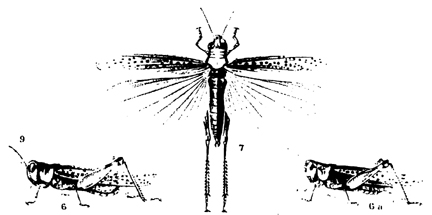
What could cause such devastation and panic? The answer is a relatively
small flying grasshopper, roughly 1.25 to 1.4 inches long, known as the
Rocky Mountain Locust. Individually, they were rather unimpressive and
caused little problem. When conditions were ideal, they could multiply
into the billions, travel over long distances, and consume virtually
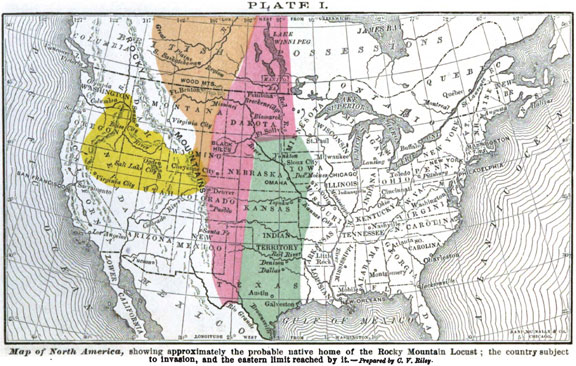
anything and everything that was remotely edible. Their native homelands
were the dry Rocky Mountain upland region of primarily Colorado, Wyoming
and Montana. After hatching out in the spring of the year, the locusts
would travel eastward in search of food. In years where the number of
those hatched was unusually large, the food supply was stripped rather
quickly driving them ever eastward in search of new food supplies.
Kansas and Nebraska were usually among their first targets and were
frequently the most devastated but the swarms spread over a large area
stretching north from the interior of Canada and extending all the way
to the south border of Texas. The eastern regions of Nebraska and Kansas
along with the western regions of Minnesota, Iowa, and Missouri were the
areas most devastated.
The Year of the Locust actually began with the first arrivals of the
swarms in the mid summer of 1874. They reached the northwestern corner
of Missouri in late July to early August. Within the coming weeks, the
locusts continued their trek in a southeast direction until they reached
the limits of their travel. Most of the heavy damage in 1874 was limited
to Kansas and Nebraska. Damage was rather light in Missouri 1874 but the
appearance of such huge numbers of the insects caused a great deal of
panic of what was feared to be coming in the spring of 1875. The fears
were realized by late April of 1875 when the spring hatch out began. The
numbers have since been estimated to be in the trillions, an
unimaginable number that has no match in all of recorded history.
Consider this quote from "Voices from the Past: What We Can Learn from
the Rocky Mountain Locust" by Jeffrey A. Lockwood:
“According to the first-hand account of A. L. Child transcribed by
Riley et al. (1880), a swarm of Rocky Mountain locusts passed over
Plattsmouth, Nebraska, in 1875. By timing the rate of movement as the
insects streamed overhead for 5 days and by telegraphing to surrounding
towns, he was able to estimate that the swarm was 1,800 miles long and
at least 110 miles wide. Based on his information, this swarm covered a
swath equal to the combined areas of Connecticut, Delaware, Maine,
Maryland, Massachusetts, New Hampshire, New Jersey, New York,
Pennsylvania, Rhode Island, and Vermont.”
Nearly every
county history from the late 1800’s in the affected areas records an
account of the devastation within their own borders. The following are
quotes from several of these county histories:
“It was the year 1875 that will long be remembered by the people of at
least four states, as the grasshopper year. The scourge struck Western
Missouri April, 1875, and commenced devastating some of the fairest
portions of our noble commonwealth. They gave Henry [County] an earnest
and overwhelming visitation, and demonstrated with an amazing rapidity
that their appetite was voracious, and that everything green belonged to
them for their sustenance. They came in swarms, they came by the
millions, they came in legions, they came by the mile, and they darkened
the heavens in their flight, or blackened the earth's surface, where in
myriads they sought their daily meal. Henry County was visited from
about the first week of May, and remained until the 1st of June, 1875,
and during that time, every spear of wheat, oats, flax and corn were
eaten close to the ground. Potatoes and all vegetables received the same
treatment, and on the line of their march, ruin stared the farmer in the
face, and starvation knocked loudly at his door.”
The History of Henry and St. Clair County, Missouri. 1883, National
Historical Company, St. Joseph, Missouri
* * *
“The
invasion of Kansas, Nebraska, Colorado and Western Missouri, by the
grasshoppers; or more properly speaking, the Rocky Mountain Locusts, in
1874, occurred in the month of August; and was fraught with great
disaster to the agricultural interests of those States and to the trade
of Kansas City. The locusts came in immense clouds and literally covered
the territory mentioned. Their first appearance was generally at a great
altitude, flying from the northwest to the southeast, and their
appearance was that of a snow storm. Sometimes they were so numerous as
to darken the sunlight. They settled gradually to the ground, when their
voracity soon made itself apparent; whole fields of green corn being
destroyed in a single day. Nothing escaped them; there appeared to be
nothing they would not eat; at least there was nothing that they did not
eat; and in their progress they left the country nearly as bare of
vegetation as if it had been scorched by fire. By the time they reached
the Missouri River section, vegetation, at least the crops, was too far
advanced for them to do material harm, but on the frontiers, where they
appeared earlier, and where the new settlers' dependence was a crop of
sod corn, necessarily late and immature, their destruction was great and
caused much suffering during the following winter. They matured
sufficiently to begin to deposit their eggs when about fifty miles west
of Kansas City, and continued until they had advanced to about fifty
miles east of it. Hence, in the spring of the year 1875, a new crop was
hatched to infest the country, and they proved no less voracious than
their progenitors of the year before. A district about a hundred miles
wide extending southward from Kansas City a hundred miles and northward
to the British possessions, was kept as bare of vegetation as midwinter
until June of 1875, when the young brood suddenly took wing and
disappeared as mysteriously as their progenitors had appeared, going in
a northwesterly direction. The effect of all this was to cost the larger
part of the country united by them the bulk of a year's crop, part of it
in the fall of 1874, and part in the spring of 1875. Such disaster could
not but affect detrimentally the business of Kansas City. Early in the
winter of 1874-5 it was ascertained that there was great suffering among
the people of western Kansas from this cause, and organized efforts for
relief began to be made. The east was appealed to and responded
liberally.”
The History of Jackson County, Missouri. 1881, Union Historical
Company, Birdsall, Williams & Co., Kansas City
* * *
"1875- 'Serious and distressing,' says Mr. Riley, 'as were the ravages
of this insect in 1874, when the winged swarms overswept several of the
western states, and poured into our western counties in the fall, the
injury and suffering that ensued were as naught in Missouri, compared to
what resulted from the unfledged myriads that hatched out in the spring
of 1875.' 'The greatest damage extended over a strip twenty-five miles
each side of the Missouri river, from Omaha to Kansas City, and then
extending south to the southwestern limit of Missouri-and Bates,
Buchanan, Barton, Clay, Cass, Clinton, Henry, Jackson, Johnson,
Lafayette, Platte, St. Clair, and Vernon, suffered most. Early in May,
the reports from the locust districts of the state were very
conflicting; the insects were confined to within short radii of their
hatching-grounds. The season was propitious, and where the insects did
not occur, everything promised well. As the month drew more and more to
a close, the insects extended the area of destruction, and the alarm
became general. By the end of the month, the non-timbered portions of
the middle western counties, were as bare as in winter. Here and there
patches of Amarantus blitem, and a few jagged stalks of milk-weed
(Asclepas) served to relieve the monotony. An occasional out-field, or
low piece of prairie, would also remain green; but with these exceptions
one might travel for days by buggy and find everything eaten off, even
to underbrush in the woods. The suffering was great and the people well
nigh disheartened. Cattle and stock of all kinds, except hogs and
poultry, were driven away to the more favored counties, and relief
committees were organized. Many families left the state under the
influence of the temporary panic and the unnecessary forebodings and
exaggerated statements of the pessimists. Chronic loafers and idlers
even made some trouble and threatened to seize the goods and property of
the well-to-do. Relief work was, however, carried on energetically, and
with few exceptions, no violence occurred.”
“In his eighth annual report Mr. Riley (then state entomologist of
Missouri) thus estimates the loss in the various counties of Missouri in
1875: Atchison, $700,000; Andrew, $500,000; Bates, $200,000; Barton,
$5,000; Benton, $5,000; Buchanan, $2,000,000; Caldwell, $10,000; Cass,
$2,000,000; Clay, $800,000; Clinton, $600,000; De Kalb, $200,000;
Gentry, $400,000; Harrison, $10,000; Henry, $800,000; Holt, $300,000;
Jackson, $2,500,000; Jasper, $5,000; Johnson, $1,000,000; Lafayette,
$2,000,000; Newton, $5,000; Pettis, $50,000; Platte, $800,000; Ray,
$75,000; Saint Clair, $850,000; Vernon, $75,000; Worth, $10,000.
Amounting in the aggregate to something over $15,000,000.”
“The vastness of the depredations of the insect are better appreciated
when it is stated that the locust area comprised nearly two million
square miles, and that Missouri suffered on an average with the other
states within that section. It is estimated that the aggregate loss in
the destruction of crops alone would reach $100,000,000, and that the
indirect stoppage in business, and the crushing of new enterprises made
fully as much more, so that direct and indirect loss was not less than
$200,000,000. Mr. F. V. Hayden, U. S. geologist, in this connection
says: "In addition to all this, we must include as a part of the effect
of locust injuries, the checking of immigration, and the depreciation in
the value of lands. So depressing, in fact, was this result in some
regions as to paralyze trade, put a stop to all new enterprises, and
dishearten the communities where the suffering was greatest."
The History of Johnson County, Missouri. 1881, Kansas City Historical
Company, Kansas City, MO
* * *
“These were the years of the great devastation in Nebraska, Kansas, and
western Missouri by the Rocky Mountain locust (Caloptemus Spretus). The
locusts came in thick flying clouds, mostly from a west or northwesterly
direction, in the fall of 1874; they destroyed what they could find then
that was green and juicy enough for them, and finally laid their eggs.
Lafayette county did not suffer greatly this year, as compared with
other counties further west and north. But when the little imps hatched
out in the spring and commenced marching eastward, eating a clean swath
as they went, then this county knew what it was to be "grasshoppered." A
correspondent of the Chicago Times wrote from Lexington, May 18, 1875:
"The grasshoppers are on the move east, eating everything green in their
road. One farmer south of this city had fifteen acres of corn eaten by
them yesterday in three hours. They mowed it down close to the ground
just as if a mowing machine had cut it. All the tobacco plants in the
upper part of the county have been eaten by them.’”
The History of Lafayette County, Missouri. 1881, Missouri Historical
Company, St. Louis, MO.
* * *
"Their flight, may be likened to an immense snow-storm, extending from
the ground to a height at which our visual organs perceive them only as
minute, darting scintillations, leaving the imagination to picture them
indefinite distances beyond. 'When on the highest peaks of the Snowy
Range, fourteen or fifteen thousand feet above the sea, I have seen them
filling the air as much higher as they could be distinguished with a
good field-glass. It is a vast cloud of animated specks, glittering
against the sun. 0n the horizon they often appear as a dust tornado,
riding upon the wind like an ominous hail-storm, eddying and whirling
about like the wild, dead leaves in an autumn storm, and finally
sweeping up to and past you, with a power that is irresistible. They
move mainly with the wind, and when there is no wind they whirl about in
the air like swarming bees. If a passing swarm suddenly meets with a
change in the atmosphere, 'such as the approach of a thunderstorm or
gale of wind, they came down precipitately, seeming to fold their wings,
and fall by the force of gravity, thousands being killed by the fall if
it is upon stone or other hard surface.'"
"An idea of the vast numbers that will sometimes descend to the ground
may be formed by the following occurrence, related to us by an
intelligent and reliable eye-witness, Mr. H. McAllister, of Colorado
Springs, Colo.: In 1875, early in August, a swarm suddenly come down at
that place. The insects came with the wind, and alighted in a rain. The
ground was literally covered two and three inches deep, and glittered
"as a new dollar" with the active multitude. In rising, the next day, by
a common impulse, their wings would get entangled, and they would drop
to the ground again in a matted mass. "In alighting, they circle in
myriads about you, beating against everything animate or inanimate,
driving into open doors and windows, heaping about your feet and around
your buildings, their jaws constantly at work biting and testing all
things in seeking what they can devour. In the midst of the incessant
buzz and noise which such a fight produces, in face of the unavoidable
destruction everywhere going on, one is bewildered and awed at the
collective power of the ravaging host, which calls to mind so forcibly
the plagues of Egypt."
"The noise their myriad jaws make when engaged in their work of
destruction can be realized by any one who has 'fought' a prairie fire
or heard the flames passing along before a brisk wind-the low crackling
and rasping; the general effect of the two sounds is very much the
same."
"Persons in the East have often smiled incredulously at our statements
that the locusts often impeded the trains on the western railroads. Yet
such was by no means an infrequent occurrence in 1874 and 1875-the
insects pawing over the track or basking thereon so numerously that the
oil from their crushed bodies reduced the traction so as to actually
stop the train, especially on an up-grade."
Report of the Commissioner of Agriculture For The Year 1877.
Washington, DC 1878.
* * *
"The
severely stricken region, covering an area variously estimated at from
200 to 275 miles from east to west, and from 250 to 350 miles from north
to south, and embracing portions of Nebraska, Kansas and Missouri,
presented a variety of experience, some portions being comparatively
exempt from injury, while others wore an aspect of devastation that
changed the verdure of spring into the barrenness of winter."
"The tract in which the injury done by the destructive enemy was worst,
was confined to the two western tiers of counties in Missouri, and the
four tiers of counties in Kansas, bounded by the Missouri river on the
east. The greatest damage extended over a strip 25 miles each side of
the Missouri river, from Omaha to Kansas City, and then extending south
to the southwestern limit of Missouri. About three-quarters of a million
of people were to a greater or less extent made sufferers. The
experience of different localities was not equal or uniform. Contiguous
farms sometimes presented the contrast of abundance and utter want,
according to the caprices of the invaders, or according as they hatched
in localities favorable to the laying of the eggs. This fact gave rise
to contradictory reports, each particular locality generalizing from its
own experience. The fact is, however, that over the region described
there was a very general devastation, involving the destruction of
three-fourth of all field and garden crops. While the injury was
greatest in the area defined above, the insects hatched in more or less
injurious numbers from Texas to British America-the prevalence of the
insects in Manitoba being such that in many parts little or no
cultivation was attempted."
The Locust Plague in the United States by Charles V. Riley. 1877,
Rand, McNally & Co., Chicago.
* * *
"In 1875, near Lane, Kansas, they crossed the Potawotomie Creek, which
is about four rods wide, by millions; while the Big and Little Blues,
tributaries of the Missouri, near Independence, the one about 100 feet
wide at its mouth, and the other not so wide, were crossed at numerous
places by the moving armies, which would march down to the water's edge
and commence jumping in, one upon another, till they would pontoon the
stream, so as to effect a crossing. Two of these mighty armies also met,
one moving east and the other west, on the river-bluff, in the same
locality, and each turning their course north and down the bluff, and
coming to a perpendicular ledge of rock 25 or 30 feet high, passed over
in a sheet apparently 6 or 7 inches thick, and causing a roaring noise
similar to a cataract of water."
Riley's Eighth Report, p. 118. recorded in First Annual Report Of The
United States Entomological Commission For The Year 1877 Relating To The
Rocky Mountain Locust
* * *
Other historical accounts have recorded that after the crops were
devoured, the locusts turned to the trees, consuming the leaves and
stripping the bark from the trees. There are some accounts that fence
posts, axe handles, cloth, leather stirrups, bridles, and gloves were
also chewed and consumed in their never ending search for food.
By late June, the locusts had done their worst and vanished as quickly
as they had arrived. Most reports state that the swarms took flight in a
northwest direction, apparently returning in the direction from which
they had originally come. Despite the lateness of the date, the people
went to work in hurriedly replanting their gardens and crops with hopes
and prayers that the crops would have enough time to mature before
winter arrived. Corn was planted as late as July 4th, which is quite
late since most corn in Missouri is planted in May to very early June. A
typical Missouri summer is hot and dry so early planting is essential to
give a reasonable chance of a successful crop. The year of 1875 was not
a typical year. The rains were plentiful and the season was longer than
usual. The result was record crops that far exceeded the yield of a
typical year. Some areas in Missouri actually were able to grow a
surplus of crops which were shipped to the hardest hit areas of Kansas
and Nebraska. It was a joyous and surprise ending to what was expected
to be a time of extended desperation with a bleak winter ahead.
While the surprisingly successful season brought much relief, there
continued to be a general fear that the next spring would see a return
of the hordes of locusts. The locusts did return to some degree in the
following two years. A great deal of study was made to attempt to
control any future invasions. Numerous inventions were patented that
were supposed to be of value in combating the pests. Most of the states
made efforts to control the locusts by a wide range of means. Bounties
were paid for the collection of quantities of the locusts, usually of $1
per bushel. Nicollet County, Minnesota paid $25,053 for 25,053 bushels
of locusts while some counties paid out even higher amounts. It will
never be known if these attempts really made much difference
While they continued to be destructive, they were always much less so
than in 1875. Never again were they as great of a threat as they had
been during that memorable year. Then, surprising, they simply
disappeared, never to be seen again. The last recorded sighting of the
Rocky Mountain Locust was in 1902.
Why did they disappear? A number of theories have been proposed but none
seem to provide a completely satisfactory answer. One suggestion is that
the widespread settlement of the prairie and the resulting plowing that
was done may have disrupted the locusts reproductive success since they
laid their eggs in the soil. A number of rainy years may have played a
role since their greatest reproductive success was when they laid their
eggs in dry soil.
While many by their own choice did stay through all of the difficulties,
others who stayed simply had no choice but to stay, they were too
destitute to move on. Others, particularly in Kansas and Nebraska
thought it best to cut their losses moved away, mostly east outside of
the area affected by the repeated plagues. The plagues, for a time at
least, slowed and some areas actually reversed the migration into the
most affected prairie region. Do you have ancestors who without
explanation moved from the counties in this region in the mid to late
1870’s? There is an excellent chance that the now extinct Rocky Mountain
Locust played a significant role in their decision.
Find more related articles concerning history and genealogy here: The Lives of Our Ancestors
Copyright © 2004-2014 Hearthstone Legacy Publications
http://www.hearthstonelegacy.com/when-the-skies-turned-to-black-the_locust-plague-of-1875.htm