Coke Is a Joke Influencing Science Just Like Politics
Story at-a-glance −
- Coca-Cola has given $120 million to health researchers, public health organizations, and other institutions over the past five years
- Research studies funded by the beverage and sugar industries are five times more likely to conclude there's "no link" between sugary beverages and weight gain
- Coca-Cola also funded a front group to promote the message that a lack of exercise – not what you’re eating and drinking – is driving obesity rates up, despite evidence to the contrary
By Dr. Mercola
In 2015, most people would raise an eyebrow, and maybe even protest, if a cigarette company like Philip Morris (which created brands like Marlboro) was funding research by a public health organization like, say, the American Lung Association.
The potential conflict is obvious, as organizations receiving large sums of money from a corporation could have their opinions, and, yes, even their research swayed to suit the needs of their corporate funders.
Yet, this type of blatant, you might say, pay off, occurs all the time in 2015, only it’s no longer the tobacco industry that’s doing all the funding. Nowadays, that title goes to many different players in the pesticide, pharmaceutical, food, and beverage industries, including what is considered by many to be an American icon – Coca-Cola.
Coca-Cola Wants to Blame Obesity on Virtually Anything Other Than Soda
As the world’s largest producer of sugary beverages, Coca-Cola has quite strong motivation to keep soda in Americans’ good graces. Yet the research is becoming too abundant to ignore.
UCLA researchers found, for instance, that adults who drank at least one sugar-sweetened beverage a day are 27 percent more likely to be overweight or obese.1 Even those who only drank soda occasionally had a 15 percent greater risk, and a growing number of studies have linked rising childhood obesity rates to increased consumption of sugary beverages as well.
But the link goes far beyond even obesity. A recent meta-review published in the Mayo Clinic Proceedings found that once you reach 18 percent of your daily calories from added sugar, there's a two-fold increase in metabolic harm that promotes pre-diabetes and diabetes.2
Moreover, research suggests sugary beverages are to blame for about 183,000 deaths worldwide each year, including 133,000 diabetes deaths, 44,000 heart disease deaths, and 6,000 cancer deaths.
Americans are catching on, with nearly two-thirds (63 percent) now saying they actively try to avoid soda in their diet.3 Rates of soda consumption have actually been dropping for decades, and Americans now consume about the same amount they did back in 1986.
Coca-Cola had to do something, but they couldn’t very well tell increasingly health-conscious Americans to drink more soda. So they went at it in a roundabout way instead, funding a front group by the name of The Global Energy Balance Network.
The New York Times broke this story in August 2015, and it turns out Coca-Cola donated $1.5 million in 2014 to start the organization.4 Their message? It’s not what you’re eating and drinking that’s making you fat, it’s a lack of exercise that’s the problem. The Times reported:5
“Health experts say this message is misleading and part of an effort by Coke to deflect criticism about the role sugary drinks have played in the spread of obesity and Type 2 diabetes.
They contend that the company is using the new group to convince the public that physical activity can offset a bad diet despite evidence that exercise has only minimal impact on weight compared with what people consume.”
What is perhaps most alarming is that this front group represents only the tip of the iceberg when it comes to Coca-Cola trying to infiltrate public health opinions…
Coca-Cola Has Given $120 Million to Academic Health Researchers, Major Medical Groups, and More
In September 2015, Coca-Cola published a detailed list of grants given to organizations since 2010. The move came after Coca-Cola Chief Executive Muhtar Kent made a promise to disclose its partnerships and support for obesity-related research.
Over the past five years alone, Coca-Cola spent nearly $120 million for such grants, bestowing them on health organizations both big and small – “physician groups, university researchers, cancer and diabetes organizations, and public parks, and even a foundation for the National Institutes of Health,” The New York Times reported.6 They continued:7
“The detailed list of grants shows the company’s remarkable reach across the United States and beyond. Beneficiaries included a number of medical and health groups.
This includes $3.1 million to the American College of Cardiology, more than $3.5 million to the American Academy of Family Physicians, nearly $3 million to the American Academy of Pediatrics, $2 million to the American Cancer Society, and roughly $1.7 million to the country’s largest organization of dietitians, the Academy of Nutrition and Dietetics.Marion Nestle, professor of Nutrition, Food Studies, and Public Health at New York University, said she was pleased that Coca-Cola had lived up to its promise to provide greater transparency, but she did not know of another food company so ‘deeply and widely entrenched in so many public organizations.’
‘What I find most remarkable about this list is its length and comprehensiveness,’ said Dr. Nestle, author of the book Soda Politics. ‘No organization, no matter how small, goes unfunded. Any scientist or dietitian who is willing to take Coca-Cola funding gets it.’”
What Happens When a Soda Company Funds Health Research?
Not surprisingly, compared to studies with no financial conflicts of interest, research funded by the beverage and sugar industries are five times more likely to conclude there's "no link" between sugary beverages and weight gain.8 Researchers noted:
“… Our results confirm the hypothesis that authors of systematic reviews may draw their conclusions in ways consistent with their sponsors' interests."
So while Sandy Douglas, the president of Coca-Cola North America, told The New York Times that their financial support of “well-respected experts, institutions, and organizations” was made “with the best of intentions,” it’s clear they could be getting quite a return on their investment. Otherwise, why else would they do it?
And it’s not only research institutions that Coca-Cola has infiltrated. They also donated more than $6 million to the Boys & Girls Clubs of America and hundreds of thousands of dollars to the N.A.A.C.P. and the Hispanic Federation.
The latter two “repaid” the company by supporting a beverage-industry lawsuit in 2013 that blocked former New York mayor Michael Bloomberg’s attempt to ban large sugary beverages from the city.9
It’s obvious how Coca-Cola stands to benefit from such relationships, but even with a scarcity of available funding for research and advocacy, it’s surprising that "credible" public health organizations would want to get tied up with this proverbial smoking gun. As Yoni Freedhoff, an obesity expert at the University of Ottawa, told The New York Times:10
“These organizations are forming partnerships with a company whose products are absolutely thought to be a major player in obesity and the spread of chronic, noncommunicable diseases…
Why in this day and age would a public health organization create even the possibility for there to be influence that might affect their ability to champion and promote public health?”
Diet Soda Drinkers More Likely to Eat Unhealthy Foods
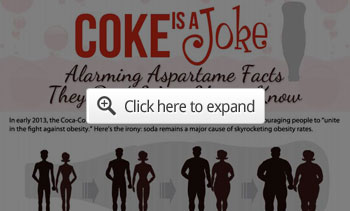
Coca-Cola is no stranger to sugarcoating the truth. One of their ongoing strategies to appear like they care about your health is to promote their diet beverages as a healthy alternative. In 2013, they rolled out an ad campaign encouraging people to unite in the fight against obesity, and then swiftly launched another campaign touting aspartame in its diet sodas.
According to the ad, aspartame is a “safe, high-quality alternative to sugar." Clearly they’ve not reviewed the hundreds of studies on this artificial sweetener demonstrating its harmful effects... or the risks of consuming diet sodas in general, which include weight gain.
In one study, people who drank diet soda had a 70 percent greater increase in waist size in a 10-year period compared to non-diet soda drinkers. Those who drank two or more diet sodas a day had a 500 percent greater increase in waist size.
Research published in the Journal of the Academy of Nutrition and Dietetics also revealed that people who drink diet beverages may end up compensating for their “saved” calories by eating more foods high in sugar, sodium, and unhealthy fats.11 Obese adults had the highest incremental daily calorie intake from unhealthy foods associated with diet beverages. Researcher Ruopeng An, a Kinesiology and Community Health professor at the University of Illinois, noted:12
"It may be that people who consume diet beverages feel justified in eating more, so they reach for a muffin or a bag of chips… Or perhaps, in order to feel satisfied, they feel compelled to eat more of these high-calorie foods."
For more on the detrimental effects of diet sodas, including in relation to weight gain, check out our infographic below.
Residents of Which US States Drink the Most Soda?
While soda consumption in the US has seen an overall downward trend, many Americans are still drinking too much. In 18 states overall, more than 26 percent of US adults drink soda or other sweetened beverages at least once daily. Many of the states with the highest soda consumption are one in the same as those with the highest sugar consumption, and many also have higher rates of obesity and other unhealthy habits, such as eating fewer fruits and vegetables.
The top soda states also tended to have lower than average median household income and lower levels of higher education compared to the national average. To determine the five US states with the highest sugar and sugar-sweetened beverage consumption, 24/7 Wall St. used data from the CDC's "Sugar-Sweetened Beverage Consumption Among Adults — 18 States, 2012" report published in August 2014.13 They include:14
1. Mississippi
- Pct. consuming soda and/or fruit drinks daily: 41.4 percent
- Obesity rate: 35.1 percent
- Pct. consuming vegetables less than daily: 23.2 percent
- Median household income: $37,963
2. Tennessee
- Pct. consuming soda and/or fruit drinks daily: 39.2 percent
- Obesity rate: 33.7 percent
- Pct. consuming vegetables less than daily: 26.8 percent
- Median household income: $44,297
3. Nevada
- Pct. consuming soda and/or fruit drinks daily: 36.3 percent
- Obesity rate: 26.2 percent
- Pct. consuming vegetables less than daily: 24.4 percent
- Median household income: $51,230
4. Oklahoma
- Pct. consuming soda and/or fruit drinks daily: 34.5 percent
- Obesity rate: 32.5 percent
- Pct. consuming vegetables less than daily: 25.4 percent
- Median household income: $45,690
5. Georgia
- Pct. consuming soda and/or fruit drinks daily: 33.1 percent
- Obesity rate: 30.3 percent
- Pct. consuming vegetables less than daily: 32.3 v
- Median household income: $47,829
Are You Trying to Cut Out Soda?
In order to break free of your soda habit, first be sure you address the emotional component of your food cravings using tools such as the Emotional Freedom Techniques (EFT). More than any traditional or alternative method I have used or researched, EFT works to overcome food cravings and helps you reach dietary success. Be sure to check out Turbo Tapping in particular, which is an extremely effective and simple tool to get rid of your soda addiction in a short amount of time.
If you still have cravings after trying EFT or Turbo Tapping, you may need to make some changes to your diet. My free nutrition plan can help you do this in a step-by-step fashion. Remember, nothing beats pure water when it comes to serving your body's needs. If you feel the urge for a carbonated beverage, try sparkling mineral water with a squirt of lime or lemon juice, or sweetened with stevia or Luo Han, both of which are safe natural sweeteners. Remember, if you struggle with high blood pressure, high cholesterol, diabetes, or extra weight, then you have insulin sensitivity issues and would likely benefit from avoiding ALL sweeteners.
Tell Coke They're a Joke!
Obesity is a serious public health problem in the US, and you are being sorely misled by companies pretending to have a solution that, in reality, only worsen the problem. I strongly urge you to let the Coca-Cola Company know how you feel by telling them to stop their deceptive marketing of soda products. Join me in taking a stand against false advertising and let your voice be heard. If you’re on Twitter, send a tweet to #CokeCEO to let Coca-Cola know you disapprove of their deceptive advertising. If you’re on Facebook, please share your thoughts with them on their Facebook Page.
You can also e-mail Coca-Cola to let them know how you feel about their strategy for fighting obesity — which does not include giving up soda and other sugary beverages. Already, in response to growing criticism, Coca-Cola CEO Muhtar Kent has issued a public apology, acknowledging that the company’s approach was “poorly planned.”15 But Coca-Cola’s campaign was hardly the result of poor planning! It was about disseminating poor science and perpetuating misleading information in order to deceive you about the influence of soda on your weight — a Big JOKE!
Coca-Cola also says “the way we have engaged the public health and scientific communities… is not working.” But this is not about engaging public health and scientific communities. It’s about trying to defend the indefensible using plain old bad/misleading information — a Big JOKE! Coke even has a “work it out calculator”16 that supposedly tells you how much you have to exercise to burn off your favorite beverage, but look at the numbers for Diet Coke...
According to them, you don’t have to spend a single minute exercising if you drink diet soda, yet overwhelming amounts of research shows artificially sweetened beverages promote weight gain to the same degree or more as regularly sweetened beverages — a Big JOKE!
© Copyright 1997-2015 Dr. Joseph Mercola. All Rights Reserved.
http://articles.mercola.com/sites/articles/archive/2015/10/07/coke-is-a-joke.aspx