Flu Vaccine: The Unpredictable Prediction
Story at-a-glance −
- Last year’s (2014 to 2015) flu vaccine was just 18 percent effective among adults, and only 15 percent among children aged 2 to 8
- One of the most widely circulating influenza A strains mutated early in the season, leaving those who had gotten a flu shot with the belief that they were protected when they were not
- This year, the CDC is still actively promoting the flu shot for Americans, despite its continuing dismal track record of failure
By Dr. Mercola
Last year's (2014 to 2015) flu season was said to be one of the worst in years… and the flu vaccine, widely pushed by public health organizations as the best way to prevent influenza, was a major failure.
In January 2015, data from the US Centers for Disease Control and Prevention (CDC) revealed the flu vaccine was only 23 percent effective last year, which means many people who received it believed they were protected from getting influenza but were not.
By February, public health officials had lowered the predicted effectiveness to just 18 percent and only 15 percent among children aged 2 to 8 – for the inactivated, injectable flu shot.1 The inhaled live virus nasal spray flu vaccine fared even worse, showing potentially no benefit for young children.2
It got so bad that, in January 2015, the CDC finally issued a warning saying the 2014 to 2015 flu vaccine was a poor match to the influenza A strain causing most cases of influenza that season.
It turned out the H3N2 strain had mutated, but health officials still urged people to get a flu shot, claiming the vaccine can make symptoms less severe without providing evidence that this is true.
In June 2015, research was published in Cell Reports showing that, indeed, the influenza A virus that had widely circulated during the 2014 to 2015 flu season had mutated. However, that mutation was not factored in when the vaccine was developed in early 2014.3 But don't worry… the CDC is confident this year's vaccine will work much better.
Health Officials Were Confident in Last Year's Flu Vaccine…
It's déjà vu. Flash back to September 2014, and the CDC was hard at work telling adults not to forget to get their annual flu shot – and to make sure to get their children vaccinated too. This, CDC Director Tom Frieden said, would be "The best way to protect yourself against the flu..."4
Both the CDC and the American Academy of Pediatrics even went so far as to say the live virus nasal spray version was the preferred vaccine for healthy children ages 2 to 8 because research showed it worked a little better for them than the inactivated injected vaccine.
Children were given two doses to inhale initially so, theoretically, they could quickly build immunity.5 But it turned out the nasal spray flu vaccine was a bigger failure than injectable flu shots.The flu vaccine is (and was) also widely recommended for pregnant women. It was around this time last year that a study came out in the New England Journal of Medicine stating the flu vaccine provided partial protection against confirmed influenza in pregnant women and their infants.6
The media began touting headlines like "flu vaccine safe for pregnant women," and one news outlet, News 4 Jax, even quoted about maternal-fetal medicine, with Dr. Erin Burnett saying, "All pregnant women should get the vaccine because it's 100 percent safe in pregnancy."7
This is quite a statement, since even the Food and Drug Administration (FDA) lists influenza (and Tdap) vaccines as either Pregnancy Category B or C biologicals, which means that adequate testing has not been done in humans to demonstrate safety for pregnant women, and it is not known whether the vaccines can cause fetal harm or affect reproduction capacity.8
After the CDC's aggressive promotion of flu shots for children, the elderly, healthy adults and pregnant women last year, we know how the story turned out – the flu vaccine was, once again, a major flop.
After Epic Failure, CDC Says This Year's Flu Vaccine Will Be Better
Fast forward to 2015, and the CDC is singing the same tune all over again. In September 2015 Frieden said in a news conference, "Get vaccinated… That's the best way to protect yourself, your family and your community against flu."9
A CDC analysis reportedly has found that the most common strains of influenza virus circulating in the US and in other regions match the strains included in this year's vaccine.10,11 Jessica Rigler, bureau chief for epidemiology and disease control at the Arizona Department of Health Services, told KPHO News:12
"We expect it [the 2015 flu vaccine] to be much more effective than last year's flu vaccine… If healthcare providers and vaccine providers are following the proper procedures, all of last year's flu vaccine should be off the shelves… Everybody who's eligible should get flu shot… That's anyone 6 months of age or older."
I'm amazed at the tenacity with which health care providers will push these questionable vaccines. I don't visit "regular" physicians often but am required to do so once every two years or so for insurance purposes.
Even now, two years later, I'm still receiving phone calls, emails, and text messages from this health care provider reminding me to get my annual flu shot!
But remember, what happened last year was the most common circulating influenza A strain making people sick mutated near the beginning of the season.
How can vaccine regulators and policymakers claim to know that this won't happen again? Influenza viruses are notorious for undergoing mutations and what's to stop that from happening again this year?Not to mention, last year certainly wasn't the first time the flu vaccine had a dismal effectiveness rate. The "gold standard" of independent evaluation and analysis of scientific evidence that a particular medical intervention actually works.
In average conditions, when a flu vaccine at least partially matches the circulating virus, 100 people need to be vaccinated in order to avoid just ONE set of influenza symptoms, according to Cochrane's findings. A meta-analysis published in The Lancet Infectious Diseases similarly concluded:13
The Cochrane Database Review, has issued no less than five reports between 2006 and 2010, all of which debunk the myth that flu vaccinations are "the most effective flu prevention method" available.
"Influenza vaccines can provide moderate protection against virologically confirmed influenza, but such protection is greatly reduced or absent in some seasons."
After Regular Flu Shot Fails Them, Seniors Are Told to Get a Higher Dose
Research has repeatedly shown that flu shots were not protecting seniors. The Lancet even concluded, "evidence for protection in adults aged 65 years or older is lacking."14 The "solution" was to come out with a new, higher dose vaccine — Fluzone High-Dose vaccine. It contains four times the amount of antigen found in a standard dose.15
Research published last year showed it may lower the risk of getting influenza by 24 percent among seniors compared to the standard-dose vaccine.16 This still isn't saying much, considering during the 2012 to 2013 flu season the standard flu vaccine was just 9 percent effective in seniors aged 65 and over.
Even when getting a vaccine with four times the dose, only one in four cases of influenza in older patients was potentially prevented. It's unclear whether the vaccine actually lowers the risk of influenza-related health complications and deaths.
The idea is that seniors need much more antigen in order to provoke the desired immune response, because studies have found that the flu vaccine creates only a weak immune response in the elderly. In essence, public health officials have realized that the flu vaccine does not work in the elderly, and their belief is that upping the dose will do the trick.
However, according to the manufacturer's safety studies, compared to the regular flu vaccine the high-dose version not only resulted in more frequent reports of common milder adverse reactions, it also caused slightly higher rates of Serious Adverse Events (SAEs).
A total of 6.1 percent of seniors injected with the regular Fluzone vaccine experienced a serious adverse event compared to 7.4 percent of those receiving the high-dose version. According to the package insert, the SAEs reported during the post-approval use of the vaccine include:17
Thrombocytopenia (abnormally low platelet count, which can result in abnormal bleeding) Guillain-Barre syndrome Myelitis (spinal cord inflammation) Optic neuritis (inflammation of the optic nerve) Lymphadenopathy (enlarged lymph nodes) Facial palsy (Bell's palsy) Paresthesia (numbness/tingling of the skin) Itchy skin Anaphylaxis (life-threatening whole-body allergic reaction) Stevens-Johnson syndrome Vasculitis (inflammatory destruction of blood vessels) Difficulty breathing, shortness of breath Chest pain Brachial neuritis (excruciating unilateral shoulder pain, followed by paralysis of shoulder) Pharyngitis and rhinitis (inflammation of the throat or pharynx, and the nose, respectively) Convulsions, fainting, and dizziness
Are You Skeptical of Getting an Annual Flu Shot?
You're right to be skeptical about an annual vaccine with this kind of questionable track record. Its effectiveness is wholly dependent on the educated "guesses" of health officials to choose the "right" influenza strains that circulate widely in any given year to include in the vaccine. And then again, they are banking on the hope that the virus won't mutate into a new strain between the time the vaccine is developed in the spring and when the "flu season" begins in the fall.
Even then, if all conditions are accounted for and you've been vaccinated against the exact same influenza strain you're likely to be exposed to in real life, the vaccine is not 100-percent effective. On a good year it may only be 60 percent effective.
In reality, during the past three flu seasons the CDC has claimed the flu vaccine's overall effectiveness was between 47 percent and 62 percent, but some experts have measured it at 0 to 7 percent.18,19 Aside from the questions regarding effectiveness, are questions regarding safety.
CDC officials direct doctors to give every child and adult in America a flu shot every year, but studies suggest that when children get a flu shot every year it can interfere with healthy immune responses and make them more likely to get influenza in certain flu seasons.20
Further, research presented at the 105th International Conference of the American Thoracic Society in San Diego revealed that children who get seasonal flu shots are more at risk of hospitalization than children who do not. In fact, children who had received the flu vaccine had three times the risk of hospitalization as children who had not. Among children with asthma, the risk was even higher.21
Separate research has also shown that the inactivated flu vaccine has limited efficacy in young children, while the live nasal vaccine leads to increased wheezing in children under 2 and increased hospitalization rates in infants aged 6 to 11 months.22 Data collected from Canada and Hong Kong during 2009 to 2010 showed that people who received the seasonal flu vaccine in 2008 had twice the risk of getting the H1N1 "swine flu" compared to those who hadn't received a flu shot.23,24,25 ABC News reported at that time how such shots may actually set you up for less "broad" protection than if you get, and recover from, a natural infection.26
Other side effects have also been reported, including Guillain-Barre syndrome (GBS). In the video above, Barbara Loe Fisher, co-founder and president of the non-profit National Vaccine Information Center (NVIC), interviews a Connecticut artist and her mother, a former professor of nursing, who developed GBS after getting a seasonal flu shot in 2008 and today is permanently disabled with total body paralysis.
Serious Questions Remain Unanswered…
For the past several years, physicians in America have been insisting that every child age 6 months to 18 years must get an annual flu shot. Making matters worse, public health officials have since ramped up those recommendations, telling EVERY person over the age of 6 months to get a flu shot, healthy or not, pregnant or not, or low risk or high. With all of those vaccinations, will you become more susceptible to influenza-related complications and death? Will your rate of hospitalization be increased… and will the flu shot even protect you from the current year's circulating strains?
We really don't know, and that's a problem. Health officials have leapt ahead with recommendations of "flu shots for all" without adequate safety studies – so by getting a flu vaccine, you are effectively offering yourself up as a laboratory rat. In other words, you are the safety study!
There remain more questions than answers when it comes to vaccinations, which is why we regularly see "mysterious" side effects – like narcolepsy – popping up after vaccinations enter widespread use. It is also not widely understood that the artificial immunity created by a vaccine is not the same as the natural immunity you acquire from a natural infection.
When children are born, they develop natural immunity to a large variety of microorganisms that they breathe, eat, and touch. The immune responses initiated by cells lining their airways, skin, and intestines are very important in creating "memory" and protection against the microorganisms they naturally come into contact with every day.
That primary line of defense is a very important step in the maturation of your child's immune system – and it's bypassed when he/she gets a vaccine. With vaccination, you are merely creating an antibody, but as a Journal of Virology study showed, unvaccinated children actually built up more antibodies against a wider variety of flu virus strains than the vaccinated children.27
And it's important to remember that although influenza can be deadly, most people who become infected recover on their own in two weeks or less with no complications and no health care required – except for some rest, plenty of water and maybe a cup of warm bone broth to make you feel better. Besides, if you really want to stay healthy during the flu season – and all year around - the statistics speak for themselves:
If you're relying solely on the flu vaccine to keep you from getting sick, you're putting your health on the line. A strong immune system remains the best defense against influenza and other infectious diseases, and this can't be achieved by simply relying on a shot. Healthy eating, exercise, sleep, stress, and vitamin D levels are all factors that should be addressed to keep you well this flu season. You can read about these and other natural ways to help fight and prevent the flu here.
Protect Your Right to Informed Consent and Defend Vaccine Exemptions
With all the uncertainty surrounding the safety and efficacy of vaccines, it's critical to protect your right to make independent health choices and exercise voluntary informed consent to vaccination. It is urgent that everyone in America stand up and fight to protect and expand vaccine informed consent protections in state public health and employment laws. The best way to do this is to get personally involved with your state legislators and educating the leaders in your community.
THINK GLOBALLY, ACT LOCALLY.
National vaccine policy recommendations are made at the federal level but vaccine laws are made at the state level. It is at the state level where your action to protect your vaccine choice rights can have the greatest impact.
It is critical for EVERYONE to get involved now in standing up for the legal right to make voluntary vaccine choices in America because those choices are being threatened by lobbyists representing drug companies, medical trade associations, and public health officials, who are trying to persuade legislators to strip all vaccine exemptions from public health laws.
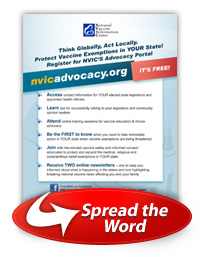
Signing up for NVIC's free Advocacy Portal at www.NVICAdvocacy.org gives you immediate, easy access to your own state legislators on your smart phone or computer so you can make your voice heard. You will be kept up-to-date on the latest state bills threatening your vaccine choice rights and get practical, useful information to help you become an effective vaccine choice advocate in your own community. Also, when national vaccine issues come up, you will have the up-to-date information and call to action items you need at your fingertips.
So please, as your first step, sign up for the NVIC Advocacy Portal.
Share Your Story with the Media and People You Know
If you or a family member has suffered a serious vaccine reaction, injury, or death, please talk about it. If we don't share information and experiences with one another, everybody feels alone and afraid to speak up. Write a letter to the editor if you have a different perspective on a vaccine story that appears in your local newspaper. Make a call in to a radio talk show that is only presenting one side of the vaccine story.
I must be frank with you; you have to be brave because you might be strongly criticized for daring to talk about the "other side" of the vaccine story. Be prepared for it and have the courage to not back down. Only by sharing our perspective and what we know to be true about vaccination will the public conversation about vaccination open up so people are not afraid to talk about it.
We cannot allow the drug companies and medical trade associations funded by drug companies or public health officials promoting forced use of a growing list of vaccines to dominate the conversation about vaccination. The vaccine injured cannot be swept under the carpet and treated like nothing more than "statistically acceptable collateral damage" of national one-size-fits-all mandatory vaccination policies that put way too many people at risk for injury and death. We shouldn't be treating people like guinea pigs instead of human beings.
Internet Resources Where You Can Learn More
I encourage you to visit the website of the non-profit charity, the National Vaccine Information Center (NVIC), at www.NVIC.org:
- NVIC Memorial for Vaccine Victims: View descriptions and photos of children and adults, who have suffered vaccine reactions, injuries, and deaths. If you or your child experiences an adverse vaccine event, please consider posting and sharing your story here.
- If You Vaccinate, Ask 8 Questions: Learn how to recognize vaccine reaction symptoms and prevent vaccine injuries.
- Vaccine Freedom Wall: View or post descriptions of harassment and sanctions by doctors, employers, and school and health officials for making independent vaccine choices.
- Vaccine Failure Wall: View or post descriptions about vaccines that have failed to work and protect the vaccinated from disease.
Connect with Your Doctor or Find a New One That Will Listen and Care
If your pediatrician or doctor refuses to provide medical care to you or your child unless you agree to get vaccines you don't want, I strongly encourage you to have the courage to find another doctor. Harassment, intimidation, and refusal of medical care is becoming the modus operandi of the medical establishment in an effort to stop the change in attitude of many parents about vaccinations after they become truly educated about health and vaccination.
However, there is hope.
At least 15 percent of young doctors recently polled admit that they're starting to adopt a more individualized approach to vaccinations in direct response to the vaccine safety concerns of parents. It is good news that there is a growing number of smart young doctors, who prefer to work as partners with parents in making personalized vaccine decisions for children, including delaying vaccinations or giving children fewer vaccines on the same day or continuing to provide medical care for those families, who decline use of one or more vaccines.
So take the time to locate a doctor, who treats you with compassion and respect and is willing to work with you to do what is right for your child.
© Copyright 1997-2015 Dr. Joseph Mercola. All Rights Reserved.
http://articles.mercola.com/sites/articles/archive/2015/10/06/flu-vaccine-major-failure.aspx