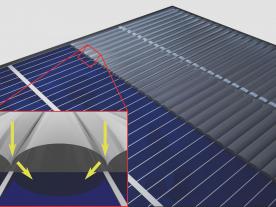
Scientists of Karlsruhe Institute of Technology (KIT) (link is external) have found an unconventional approach to increase the efficiency of solar cells: Optical invisibility cloaks which guide sunlight around objects that cast a shadow on the solar panel. They believe that these invisibility cloaks could increase the efficiency by up to 10%.
The so-called contact fingers that extract the current generated are shadow casting objects which can be found on every solar cell. Up to one tenth of the surface area of solar cells is covered by them. At the locations of these contact fingers, light cannot reach the active area of the solar cell and efficiency of the cell decreases.
“Our model experiments have shown that the cloak layer makes the contact fingers nearly completely invisible,” doctoral student Martin Schumann of the KIT Institute of Applied Physics says, who con-ducted the experiments and simulations. Physicists of KIT around project head Carsten Rockstuhl, together with partners from Aachen, Freiburg, Halle, Jena, and Jülich, modified the optical invisibility cloak designed at KIT for guiding the incident light around the contact fingers of the solar cell.
Normally, invisibility cloak research is aimed at making objects invisible. For this purpose, light is guided around the object to be hidden. This research project did not focus on hiding the contact fingers visually, but on the deflected light that reaches the active surface area of the solar cell thanks to the invisibility cloak and, hence, can be used.
To achieve the cloaking effect, the scientists pursued two approaches. Both are based on applying a polymer coating onto the solar cell. This coating has to possess exactly calculated optical properties, i.e. an index of refraction that depends on the location or a special surface shape. The second concept is particularly promising, as it can potentially be integrated into mass production of solar cells at low costs. The surface of the cloak layer is grooved along the contact fingers. In this way, incident light is refracted away from the contact fingers and finally reaches the active surface area of the solar cell.
By means of a model experiment and detailed simulations, the researchers demonstrated that both concepts are suited for hiding the contact fingers. In the next step, it is planned to apply the cloaking layer onto a solar cell in order to determine the efficiency increase. The physicists are optimistic that efficiency will be improved by the cloak under real conditions: “When applying such a coating onto a real solar cell, optical losses via the contact fingers are supposed to be reduced and efficiency is assumed to be increased by up to 10%,” Martin Schumann says.
Copyright © 2015 BVA Media Group