|
September 4, 2015
|
2nd Article This Week Indicating Mantle Plumes Far Larger Than Previous Studies |
|

by
Mitch Battros - Earth Changes Media
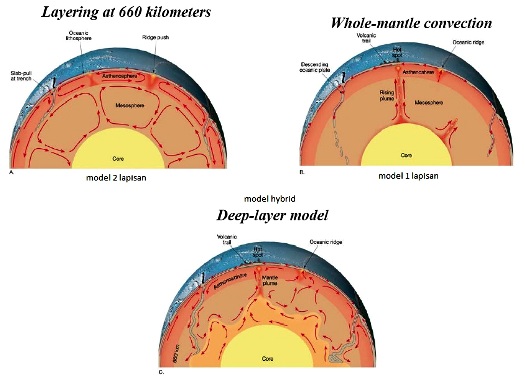
University of California, Berkeley, seismologists have
produced for the first time a sharp, three-dimensional
scan of Earth's interior that conclusively connects
plumes of hot rock rising through the mantle with
surface hotspots around the world. A computed to
mography, or CT scan, of Earth's interior, the picture
emerged from a supercomputer simulation at the
Department of Energy's National Energy Research
Scientific Computing Center (NERSC) at the Lawrence
Berkeley National Laboratory.
Until now, evidence for the plume and hotspot theory
had been circumstantial, and some seismologists
argued instead that hotspots are very shallow pools
of hot rock feeding magma chambers under volcanoes.
New
Equation:
Increase Charged Particles → Decreased Magnetic Field →
Increase Outer Core Convection → Increase of Mantle
Plumes → Increase in Earthquake and Volcanoes → Cools
Mantle and Outer Core → Return of Outer Core Convection
(Mitch Battros - July 2012)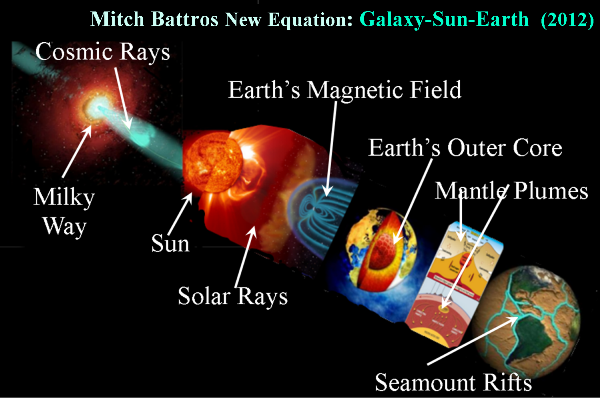
My research beginning back in 2005, had taken note of
mantle plumes as related to the Sun-Earth connection. In
2012, I published my new 'equation' (first one 1998)
which shows not only the increase of solar particles
heating the Earth's core, but the accelerated source of
galactic cosmic rays coming from our galaxy Milky Way,
is "over-heating" Earth's core. The core's natural
cyclic reaction is to reduce these thermal spikes in a
similar way humans diffuse overheating by sweating
through our pores.
Mantle plumes have the same function as our perspiring.
When Earth overheats, it sweats through its pores until
it reaches an ambient temperature. Unfortunately, when
Earth goes through its process, it is evidenced by
warming oceans that is often the cause of extreme
weather - it also creates such things as earthquakes and
volcanoes.
I will go further to say the later chapters of this
cycle the Earth has seen many times before - will be the
formation of a bulge usually somewhere around the
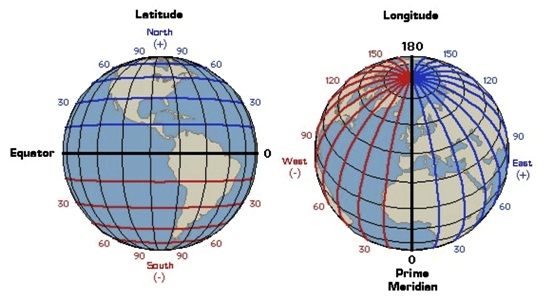
equator. As the bulge develops, magnetic north will
osculate in significant ways - such as dropping down to
30° latitude as in Texas. The last chapter of this
process is indeed a full magnetic flip. The only thought
in question is how far into the process of an estimated
40,000 year cycle are we? Some scientists believe we
could witness such an event "in our lifetime" - this is
if you are age 20 or younger. My research agrees with
this hypothesis and we should all be able to witness the
phases over the next 50-60 years.
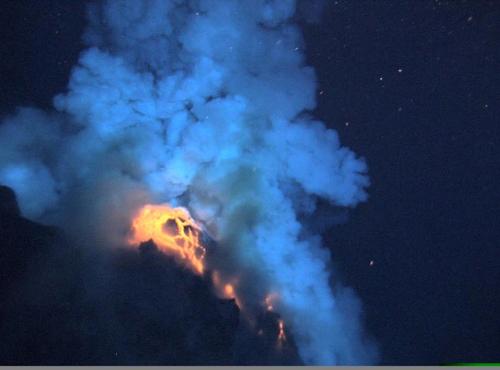
New Technology Has Better Eyes
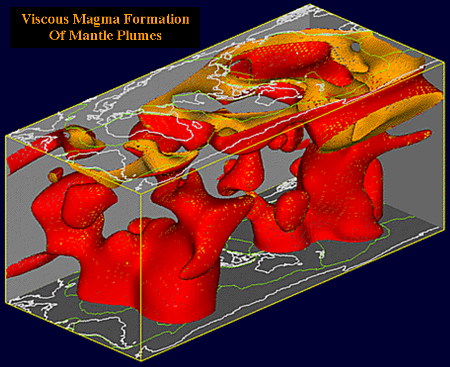
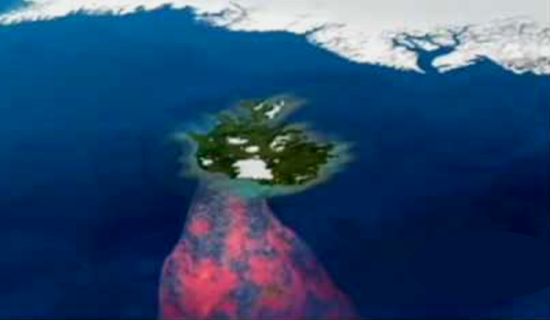
The new, high-resolution map of the mantle not only
shows these connections for many hotspots on the
planet, but reveals that below about 620 miles
(1,000 kilometers) the plumes are between 373-620
miles (600-1,000 kilometers) across, up to five
times wider than geophysicists thought. The plumes
are likely at least 400 degrees Celsius hotter than
surrounding rock.
While medical CTs employ X-rays to probe the body,
the scientists mapped mantle plumes by analyzing the
paths of seismic waves bouncing around Earth's
interior after 273 strong earthquakes that shook the
globe over the past 20 years. Previous attempts to
image mantle plumes have detected pockets of hot
rock rising in areas where plumes have been
proposed, but it was unclear whether they were
connected to volcanic hotspots at the surface or the
roots of the plumes at the core mantle boundary
1,800 miles (2,900 kilometers) below the surface.
"No one has seen before these stark columnar objects
that are contiguous all the way from the bottom of
the mantle to the upper part of the mantle," said
first author Scott French, a computational scientist
at NERSC who recently received his Ph.D. from UC
Berkeley.
Senior author Barbara Romanowicz, a UC Berkeley
professor of earth and planetary science, noted that
the connections between the lower-mantle plumes and
the volcanic hotspots are not direct because the
tops of the plumes spread out like the delta of a
river as they merge with the less viscous upper
mantle rock.

The new picture also shows that the bases of these
plumes are anchored at the core-mantle boundary in
two huge blobs of hot rock, each about 3,100 miles
(5,000 kilometers) in diameter, that are likely
denser than surrounding rock. Romanowicz estimates
that those two anchors - directly opposite one
another under Africa and the Pacific Ocean - have
been in the same spots for 250 million years.
Earth Changes Media | P. O. Box 31775 | Seattle | WA | 98103 Mitch Battros |
|