Hawaii’s Going 100 Percent Renewable Without Using Natural Gas
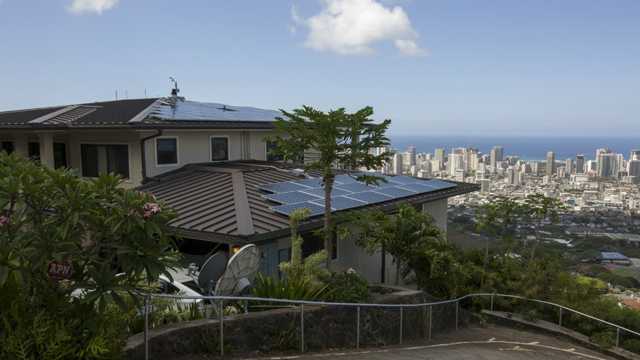
Hawaiian Gov. David Ige said this week he opposes plans to use liquefied natural gas as a “transitional fuel” for the island state as it moves to 100 percent renewable electricity. Ige said investment in infrastructure for LNG — or any fossil fuel — was misplaced, and he expressed doubt that there would be any monetary benefits to LNG proposals.
“LNG is a fossil fuel. LNG is imported. And
any time or money spent on LNG is time and money not spent on renewable
energy,” Ige told the audience at the Asia Pacific Resilience Innovation
Summit and Expo in Honolulu on Monday night.
The governor’s remarks are especially
significant because Florida-based NextEra Energy is trying to purchase
Hawaii’s major utilities. NextEra is an electric utility that also
produces natural gas, which makes up a large portion of its generation
mix.
Hawaii’s public utility corporation (PUC)
is currently reviewing NextEra’s bid, after the board of the Hawaiian
Electric Companies, which serve most of Hawaii between three providers,
approved the deal. Hawaiians have voiced concern that NextEra will
transition the state’s power fleet from oil to natural gas. Hawaii gets
more of its electricity from oil than any other state — and it has the
highest electricity rates.
For the first time, we were watching a car
being powered by the ocean…this is really the kind of stuff we should be
focusing on Natural gas has long been touted as a “transitional” fuel —
a lower-carbon option than burning coal that can be used until even
lower-carbon options such as wind
and solar ramp up. But methane emissions from LNG development,
especially fracking, are even more potent than carbon in terms of
trapping heat. Many environmentalists argue that the switch to natural
gas is not an effective means of addressing climate change. And volatile
prices can make installing new natural gas infrastructure risky.
But moving to natural gas might not help
lower costs, said State Rep. Chris Lee, chair of Hawaii’s Committee on
Energy and Environmental Protection.
“When you factor in infrastructure to make
LNG available, it may not pencil out,” he told ThinkProgress. And when
you look at LNG’s cost “both economically and environmentally both here
and at the source, then it definitely doesn’t pencil out.”
Instead, Lee said, the state should be
investing in more renewable energy sources.
“There’s all kinds of new technology and
offshore renewables that we can integrate into our grid right now,” he
said.
Hawaii is already home to the first
grid-tied wave power device, installed earlier this summer. This week,
the state added its first modern ocean thermal energy conversion (OTEC)
project, Lee said. OTEC is the process of using the temperature
difference between warm and cold ocean water to generate electricity. At
the launch of the project, the operators connected houses and charged a
Tesla car.
“For the first time, we were watching a car
being powered by the ocean,” Lee said. “It was really exciting. This is
really the kind of stuff we should be focusing on.”
Hawaii is arguably the most renewable state
in the nation. One out of every eight homes has solar power, and the
state’s commitment to use 100
percent renewable energy by 2045 is the most aggressive renewable
portfolio standard in the country.
“We have crazy high penetration with PV,”
Lee said. “And there is still so much headroom above that.”
Apparently, the governor agrees.
“When it was first proposed, I was willing
to support it as a ‘transitional fuel’ because it had some clear
advantages for Hawaii,” Ige said. “Much has changed since then. LNG will
no longer save us any money. Meeting EPA rules, even assuming the rules
do go into effect, can be handled in other ways without huge
cost. And the capital plans of those wishing to import LNG are anything
but small.”
The PUC is expected to rule on NextEra’s
bid in the first half of next year. But first, all during September and
October, the commission will hold “listening sessions” across the
islands, testing the public’s appetite for an out-of-state, natural-gas
affiliated utility.
Source(s):
thinkprogress.org
http://www.healthfreedoms.org/hawaiis-going-100-percent-renewable-without-using-natural-gas/