Ruined Chernobyl nuclear plant to remain a threat for 3,000 years
The "Energy Worker" palace of culture was once where Alexandr Sirota's mother worked in Ukraine. Deemed as a shining example of the future of the Soviet Union, the town was abandoned after the Chernobyl accident at the nuclear power plant it was built to serve. (Claudia Himmelreich/McClatchy DC/TNS)
First Detailed Assessment of Chernobyl Damage Released
VIENNA, Austria, September 6, 2005 (ENS) - A total of up to 4,000 people could eventually die of radiation exposure from the Chernobyl nuclear power plant accident nearly 20 years ago, an international team of more than 100 scientists has concluded. But as of mid-2005, fewer than 50 deaths had been directly attributed to radiation from the disaster.
Nearly all of the 50 people who died were highly exposed rescue workers, many who died within months of the accident but others who died as late as 2004.
The new numbers are presented in a landmark digest report, "Chernobyl’s Legacy: Health, Environmental and Socio-Economic Impacts," released Monday by the Chernobyl Forum.
Members of the Forum, including representatives of the three most affected governments - Belarus, Russia and Ukraine - are meeting today and tomorrow in Vienna at an unprecedented gathering of the world’s experts on Chernobyl, radiation effects and protection, to consider these findings and recommendations.
The report’s estimate for the eventual number of deaths is far lower than earlier, well publicized speculations that radiation exposure would claim tens of thousands of lives.
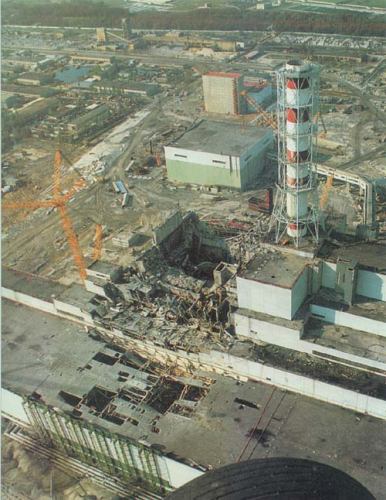
On April 26, 1986, reactor #4 at the Chernobyl Nuclear Power Station, 100 kilometers north of Kiev, exploded and caught fire. Nearly nine tons of radioactive material, 90 times as much as the Hiroshima bomb, were released. (Photo courtesy Ukranian Web)
But the 4,000 figure is not far different from estimates made in 1986 by Soviet scientists, according to Dr. Mikhail Balonov, a radiation expert with the International Atomic Energy Agency in Vienna, who was a scientist in the former Soviet Union at the time of the accident.As for environmental impact, the scientific assessments show that, except for the still closed, highly contaminated 30 kilometer area surrounding the reactor, and some closed lakes and restricted forests, radiation levels have mostly returned to acceptable levels.
"In most areas the problems are economic and psychological, not health or environmental," reports Balonov, the scientific secretary of the Chernobyl Forum effort who has been involved with Chernobyl recovery since the disaster occurred.
The Forum is made up of eight United Nations agencies, including the International Atomic Energy Agency, World Health Organization, United Nations Development Programme, Food and Agriculture Organization, United Nations Environment Programme, United Nations Office for the Coordination of Humanitarian Affairs, United Nations Scientific Committee on the Effects of Atomic Radiation, and the World Bank, as well as the governments of Belarus, Russia and Ukraine.
“This compilation of the latest research can help to settle the outstanding questions about how much death, disease and economic fallout really resulted from the Chernobyl accident,” said Dr. Burton Bennett, chairman of the Chernobyl Forum and an authority on radiation effects.
“The governments of the three most affected countries have realized that they need to find a clear way forward, and that progress must be based on a sound consensus about environmental, health and economic consequences and some good advice and support from the international community,” Bennett said.
In Washington, DC, Michael Mariotte, executive director of Nuclear Information and Resource Service, an anti-nuclear advocacy organization, said the statement issued by the Chernobyl Forum wrongly downplays the impact of the Chernobyl disaster.
"Although the report itself remains unavailable to the public," said Mariotte, "the press release states that 4,000 people are likely to die as a result of the Chernobyl accident. This is in stark contrast to industry propaganda that insists the deaths of only about 32 to 36 emergency responders can be directly attributable to the accident."
"To dismiss the loss of 4,000 lives, not to mention the non-fatal cancers and other effects, hundreds of billions of dollars in damages and permanent loss of land use, as the report appears to do, is an obscene disregard for human life and wellbeing," Mariotte declared.
Saying the fire and explosion at Chernobyl Unit 4 was "a very serious accident with major health consequences," still, Bennett said the team has "not found profound negative health impacts to the rest of the population in surrounding areas, nor have we found widespread contamination that would continue to pose a substantial threat to human health, with a few exceptional, restricted areas.”
The major health consequences were experienced by thousands of workers exposed in the early days who received very high radiation doses, and thousands more who developed thyroid cancer, according to the report.
The digest, based on a three-volume, 600-page report and incorporating the work of hundreds of scientists, economists and health experts, assesses the 20 year impact of the largest nuclear accident in history.
The Forum’s report aims to help the affected countries understand the true scale of the accident consequences and also suggest ways the governments of Belarus, Ukraine and Russia might address major economic and social problems stemming from the accident.
One serious environmental concern is that structural elements of the sarcophagus built to contain the damaged reactor have degraded, posing a risk of collapse and the release of radioactive dust.
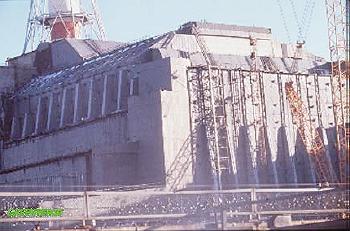
A sarcophagus was erected to contain radioactivity from the ruined reactor. (Photo courtesy Shirley/Greenpeace)
The protective shelter was erected quickly, which led to some imperfections in the shelter itself and did not permit gathering complete data on the stability of the damaged unit, said the Forum, pointing out that some structural parts of the shelter have corroded in the past two decades.Strengthening of those unstable structures has been performed recently, and construction of a New Safe Confinement covering the existing shelter that should serve for more than 100 years, starts in the near future.
The new cover will allow dismantlement of the current shelter, removal of the radioactive fuel mass from the damaged unit and, eventually, decommissioning of the damaged reactor.
A comprehensive strategy still has to be developed for dealing with the high level and long-lived radioactive waste from past remediation activities, the Forum said. Much of this waste was placed in temporary storage in trenches and landfills that do not meet current waste safety requirements.
Health Effects of Chernobyl Explosion and Fire
- Approximately 1,000 on-site reactor staff and emergency workers were heavily exposed to high-level radiation on the first day of the accident; among the more than 200,0001 emergency and recovery operation workers exposed during the period from 1986-1987, an estimated 2,200 radiation-caused deaths can be expected during their lifetime.
- An estimated five million people currently live in areas of Belarus, Russia and Ukraine that are contaminated with radionuclides due to the accident; about 100,000 of them live in areas classified in the past by government authorities as areas of "strict control." "The existing zoning definitions need to be revisited and relaxed in light of the new findings," the Forum recommends.
- About 4,000 cases of thyroid cancer, mainly in children and adolescents at the time of the accident, have resulted from the accident’s contamination and at least nine children died of thyroid cancer; however the survival rate among such cancer victims, judging from experience in Belarus, has been almost 99 percent.
- Most emergency workers and people living in contaminated areas received relatively low whole body radiation doses, comparable to natural background levels. As a consequence, no evidence or likelihood of decreased fertility among the affected population has been found, nor has there been any evidence of increases in congenital malformations that can be attributed to radiation exposure.
- Poverty, lifestyle diseases now rampant in the former Soviet Union and mental health problems pose "a far greater threat to local communities than does radiation exposure," the Forum reports.
“Two decades after the Chernobyl accident, residents in the affected areas still lack the information they need to lead the healthy and productive lives that are possible,” explains Louisa Vinton, Chernobyl focal point at the UNDP. “We are advising our partner governments that they must reach people with accurate information, not only about how to live safely in regions of low-level contamination, but also about leading healthy lifestyles and creating new livelihoods.”
While recognizing the ongoing problems, Dr. Michael Repacholi, manager of the World Health Organization's Radiation Program, said, "the sum total of the Chernobyl Forum is a reassuring message."
He explains that there have been 4,000 cases of thyroid cancer, mainly in children, but that except for nine deaths, all of them have recovered. "Otherwise, the team of international experts found no evidence for any increases in the incidence of leukemia and cancer among affected residents."
Repacholi concludes that “the health effects of the accident were potentially horrific, but when you add them up using validated conclusions from good science, the public health effects were not nearly as substantial as had at first been feared.”

One of the children who lived in the vicinity of Chernobyl and developed thyroid cancer. At the time this photo was taken in 1995, he was undergoing treatment at the Ukranian National Centre for Radiation Medicine. (Photo courtesy Shirley/Greenpeace)
In the health area, the Forum report calls for continued close monitoring of workers who recovered from Acute Radiation Syndrome and other highly exposed emergency personnel. Focused screening of children exposed to radioiodine for thyroid cancer and highly exposed clean-up workers for non-thyroid cancers should be a top priority, the report recommends.In the environmental realm, the report calls for long term monitoring of caesium and strontium radionuclides to assess human exposure and food contamination and to analyze the impacts of remedial actions and radiation-reduction countermeasures.
Better information needs to be provided to the public about the persistence of radioactive contamination in some food products and about food preparation methods that reduce radionuclide intake. Restrictions on harvesting of some wild food products are still needed in some areas.
Also in the realm of protecting the environment, the report calls for an “integrated waste management program for the Shelter, the Chernobyl NPP site and the Exclusion Zone” to ensure application of consistent management and capacity for all types of radioactive waste.
Waste storage and disposal must be dealt with in a comprehensive manner across the entire Exclusion Zone, the report urges.
In areas where human exposure is not high, no remediation needs to be done, points out Balonov. “If we do not expect health or environmental effects, we should not waste resources and effort on low priority, low contamination areas,” he says. “We need to focus our efforts and resources on real problems.”
Environmental Effects of the Chernobyl Explosion and Fire
- Major releases of radionuclides continued for 10 days and contaminated more than 200,000 square kilometers of Europe. The extent of deposition varied depending on whether it was raining when contaminated air masses passed.
- Most of the strontium and plutonium isotopes were deposited within 100 kilometers of the damaged reactor. Radioactive iodine, of great concern after the accident, has a short half-life, and has now decayed away. Strontium and caesium, with a longer half life of 30 years, persist and will remain a concern for decades. Although plutonium isotopes and americium 241 will persist perhaps for thousands of years, their contribution to human exposure is low.
- Open surfaces, such as roads, lawns and roofs, were most heavily contaminated. Residents of Pripyat, the city nearest to Chernobyl, were quickly evacuated, reducing their potential exposure to radioactive materials. Wind, rain and human activity has reduced surface contamination, but led to secondary contamination of sewage and sludge systems. Radiation in air above settled areas returned to background levels, though levels remain higher where soils have remained undisturbed.
- In agricultural areas, weathering, physical decay, migration of radionuclides down the soil and reductions in bioavailability have led to a reduction in the transfer of radionuclides to plants and animals.
- Radioactive iodine, rapidly absorbed
from grasses and animal feed into milk,
was an early concern. Elevated levels
were seen in some parts of the former
Soviet Union and Southern Europe, but,
given the nuclide’s short half life,
this concern abated quickly.
Currently and for the long term, radiocaesium, present in milk, meat and some plant foods, remains the most significant concern for internal human exposure, but, with the exception of a few areas, concentrations fall within safe levels, the report states.
- Following the Chernobyl explosion,
animals and vegetation in forest and
mountain areas had high absorption of
radiocaesium, with persistent high
levels in mushrooms, berries and game.
Because exposure from agricultural products has declined, the relative importance of exposure from forest products has increased and will only decline as radioactive materials migrate downward into the soil and slowly decay.
- The high transfer of radiocaesium
from lichen to reindeer meat to humans
was seen in the Artic and sub-Arctic
areas, with high contamination of
reindeer meat in Finland, Norway,
Russia, and Sweden. The concerned
governments imposed some restrictions on
hunting, including scheduling hunting
season when animals have lower meat
contamination.
Contamination of surface waters throughout much of Europe declined quickly through dilution, physical decay, and absorption of radionuclides in bed sediments and catchment soils.
But because of bioaccumulation in the aquatic food chain, elevated concentrations of radiocaesium were found in fish from lakes as far away as Germany and Scandinavia.
- Comparable levels of radiostrontium, which concentrates in fish bone, not in muscle, were not significant for humans. Levels in fish and waters are currently low, except in areas with "closed" lakes that have no outflowing streams. In those lakes, levels of radiocaesium in fish will remain high for decades and the Forum recommends that restrictions on fishing there should be maintained.
- The most effective early
agricultural countermeasure was removing
contaminated pasture grasses from animal
diets and monitoring milk for radiation
levels. Treatment of land for fodder
crops, clean feeding and use of
Cs-binders - that prevented the transfer
of radiocaesium from fodder to milk -
led to large reductions in contamination
and permitted agriculture to continue,
though some increase in radionuclide
content of plant and animal products has
been measured since the mid-1990s when
economic problems forced a cutback in
treatments.
Some agricultural lands in the three countries have been taken out of use until remediation is undertaken.
- A number of measures applied to
forests in affected countries and in
Scandinavia have reduced human exposure,
including restrictions on access to
forest areas, on harvesting of food
products such as game, berries and
mushrooms, and on the public collection
of firewood, along with changes in
hunting to avoid consumption of game
meat where seasonal levels of
radiocaesium may be high.
Low income levels in some areas cause local residents to disregard these rules.
- Increased mortality of evergreen
trees, soil invertebrates and mammals
and reproductive losses in plants and
animals were seen in high exposure areas
up to a distance of 30 kilometers around
Chernobyl. Outside that zone, no acute
radiation-induced effects have been
reported.
With reductions of exposure levels, biological populations have been recovering, though the genetic effects of radiation were seen in both somatic and germ cells of plants and animals.
Prohibiting agricultural and industrial activities in the exclusion zone permitted many plant and animal populations to expand and created, paradoxically, "a unique sanctuary for biodiversity," the Forum reports.