Permanent Shift? 2015 landmark year for energy
New energy technologies in the United States made further critical advances and locked in long-term gains in 2015, according to a new study from Bloomberg New Energy Finance (BNEF) and the Business Council for Sustainable Energy (BCSE) -- the fourth annual Sustainable Energy in America Factbook.
 |
|
Credit: BCSE |
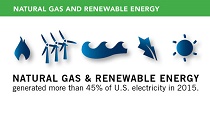
Among other achievements, energy efficiency continued to rise, renewable power generation set new records, and natural gas consumption and production surged as CO2 emissions fell to levels not seen since the 1990s, while power prices remained flat.
"The already rapid decarbonization of the U.S. power sector accelerated with record numbers of coal plant closures and solar photovoltaic system commissionings, while natural gas production and consumption hit an all-time high," the report's Executive Summary reads. "Concurrently, the U.S. continued to enjoy greater benefits from energy efficiency efforts as economic growth outpaced the growth in electricity consumption."
These are definitely powerful times for the nation's energy sector.
"2015 clearly marked a turning point for American energy," said Lisa Jacobson, president of the Business Council for Sustainable Energy. "As we consider the post-Paris world, we should acknowledge that we've entered a new era here in the United States. We now have both the tools and the capacity to achieve carbon reductions and cost savings along with economic growth. Now our job is to continue to build on the progress we've made."
The Factbook notes that renewable energy is a prominent part (20 percent) of the U.S. 2015 power fleet, with 222 GW of installed capacity across the country, a 57 percent increase over 2008 levels, resulting in a diverse electricity portfolio that is reliable and reduces emissions and costs.
"Wind power is two-thirds cheaper than it was six years ago, and after installing eight gigawatts of clean wind energy last year we're going to keep this American success story going," said Tom Kiernan, CEO of the American Wind Energy Association. "Now that there's long-term policy certainty in place, and with states and utilities increasingly looking to lock in low-cost wind energy to reach their Clean Power Plan carbon reductions, now is a great time to invest in American wind power. Wind energy is well on its way to reliably supplying 20 percent of the country's electricity by 2030."
In terms of economic growth, the report reveals that energy productivity -- the ratio of U.S. GDP to energy consumed -- continues to increase, improving by 2.3 percent from 2014 to 2015 following a 1.1 percent increase the previous year. U.S. GDP has grown by 10 percent since 2007, while primary energy consumption has fallen by 2.4 percent over the same period.
Within the electricity sector, specifically, this decoupling between energy consumption and economic growth is even more visible: electric load growth in 2015 was just 0.5 percent compared to a projected 2.4 percent increase in GDP. Since 2007, electricity demand has been flat, compared to an annual growth rate of 2.4 percent from 1990 to 2000.
In terms of economic competitiveness, the continued low cost of power allows the U.S. to potentially out-compete a number of other countries on electricity charges for businesses, with average industrial retail rates in the U.S. (7.1¢/kWh in 2014) far below those of Germany (15.9¢/kWh), China (14.3¢/kWh) and even India (10.7¢/kWh), according to the report.
Globally, the U.S. held its place as the second-most attractive country for clean energy investment, the report notes, although it remains behind China, which received $111 billion worth of capital flows into the sector compared to the U.S. $56 billion.
"Last year was certainly one for the history books: U.S. power sector CO2 emissions fell to their lowest annual level since the mid-1990s. And the net impact on consumers is negligible to positive as prices for electricity and fuel remained low by historic standards and customer choices expanded," said Colleen Regan, senior analyst at BNEF. "Perhaps most importantly, many of the key changes seen in 2015 are likely permanent shifts, rather than temporary adjustments due to one-time events."
For more:
- visit this
website
© 2016 FierceMarkets, a division of Questex, LLC. All rights reserved.
http://www.smartgridnews.com/story/permanent-shift-2015-landmark-year-energy/2016-02-05