Russia's checkered history on oil supply deals with OPEC
London (Platts)--1 Feb 2016 944 am EST/1444 GMT
Speculation over a joint effort by OPEC and Russia to support oil
prices by cutting output reached fever pitch this week after Moscow
said it was ready to discuss a coordinated approach with the
producer group.
The issue is likely to be discussed at a joint meeting next month,
energy minister Alexander Novak has said. There has been no
confirmation, however, from OPEC kingpin Saudi Arabia.
It is not the first time that Russia and OPEC have sought to join
forces to support prices by curbing production or exports. But
Russia's past collaboration with OPEC has been fraught with tensions
over market share.
Pressured by OPEC to help support oil prices, Moscow has enacted
some cuts but the reductions have been limited and brief.
The following are some highlights of the cooperation over oil
supplies between OPEC and Russia:
[click image to view at
full-size]
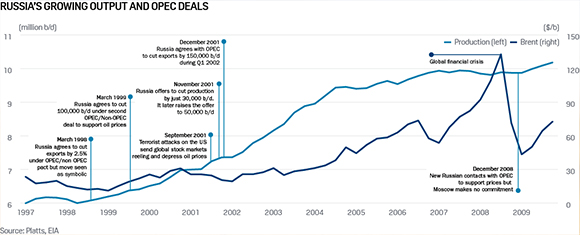
--March 1998: OPEC agrees to cut output by 2.6
million b/d to support prices after crude drops to $12/b from more
than $22/b in January 1997. As part of an OPEC/non-OPEC output cut
agreement, Russia agreed to reduce exports by 61,000 b/d, but this
was largely symbolic given its export level of around 2.4 million
b/d.
Eventually, Russia's crude production fell by 70,000 b/d, or 1% year
on year, to 6.1 million b/d in 1998. At the same time, its exports
rose by around 100,000 b/d, or 3.5% on year, to 2.4 million b/d.
--March 1999: As prices plummet to $10/b, OPEC
agreed a new output cut of 2 million b/d, with non-OPEC Russia, Oman
and Mexico also agreeing to contribute 300,000 b/d of the total.
Russia agrees to cut oil production by 100,000 b/d. Despite the
agreement, Russia's output rose by 50,000 b/d to 6.13 million b/d in
1999. Its crude exports to international markets, however, fell by
70,000 b/d to 2.33 million b/d in 1999 as Russia redirected some
volumes to the FSU markets.
--September 2001: Terrorist attacks on America send
global stock markets reeling and depress oil prices amid fears of a
further global slowdown.
--November 2001: After pressure from Saudi Arabia,
Russia offers to cut production by just 30,000 b/d. It later raises
the offer to 50,000 b/d.
--December 2001: Following continued pressure by
OPEC to help support prices, Russia agrees to cut exports by 150,000
b/d during Q1 2002. Despite the deal, Russian production was little
changed over the quarter at 7.36 million b/d, according to US EIA
figures.
--December 2008: When oil prices dropped to below
$40/b in December 2008 from record highs of $147/b in July that
year, Russia's contacts with OPEC intensified again. High-level
Russian officials met with top OPEC officials to discuss the
situation in the market.
In the second half of the year, OPEC agreed on the biggest-ever
production cut of 4.2 million b/d, in a series of agreements, but
was also seeking additional support from non-OPEC producers. Moscow
said it could reduce output by around 300,000 b/d, although Moscow
took no commitments.
--November 2014: As prices started to fall again
from more than $115/b in mid-June to below $70/b in November,
contacts between Russia and OPEC resumed. Russia took part in a
number of meetings with OPEC and non-OPEC countries, but they did
not result in any sort of agreement, with the participants
repeatedly denying special actions to balance the market were
considered.
--Nadia Rodova,
nadia.rodova@platts.com
--Robert Perkins,
robert.perkins@platts.com
--Edited by Jason Lindquist,
jason.lindquist@platts.com
© 2015 Platts, The McGraw-Hill Companies Inc. All rights reserved. To subscribe or visit go to: http://www.platts.com
http://www.platts.com/latest-news/oil/london/russias-checkered-history-on-oil-supply-deals-26354725