Cooking from Scratch Is so Important for Health, Some Medical Schools Are Now Teaching Doctors Cooking Skills
Story at-a-glance −
- Tulane University School of Medicine is now teaching medical students how to cook with real ingredients, in the hopes they may educate patients on healthier eating habits
- A processed food diet increases your risk of obesity and chronic diseases associated with insulin and leptin resistance, courtesy of the excess fructose and lack of healthy fats and fiber in processed foods
- How you cook your food influences its benefits and risks, as does the type of cooking oil you use. Ideally, use lower heat, and cook with stable fats like coconut oil, butter, and ghee
By Dr. Mercola
One of the easiest and best ways to improve your health and avoid disease is to eat real food; cooking your meals from scratch using whole ingredients, ideally organic, to avoid chemical additives and contaminants like pesticides.
Sadly, doctors have been notoriously clueless about nutrition as a way to improve health. On average, medical students in the U.S. receive less than 24 hours of nutrition instruction.1 But that may be slowly changing.
I would also add that doctors who grow their own food and understand regenerative agriculture and the similarities between human health also have a distinct advantage.
Medical School Teaches Doctors How to Cook
Tulane University School of Medicine in New Orleans has implemented a radically different curriculum, teaching their medical students not only about nutrition in general, but also the practical aspects of cooking with real ingredients.
As noted by Dr. Timothy Harlan, executive director at the Goldring Center for Culinary Medicine at Tulane:2
"We know from the literature that when people go home and start cooking from real ingredients for themselves that their health improves. We also know that they don't really know how to do that."
The goal is for Tulane-educated doctors to have the necessary skills to actually teach their patients what to cook, how to cook it, and why. Other medical schools are also following suit.
The curriculum, which was developed with the College of Culinary Arts at Johnson & Wales University, has also been bought by 16 other medical schools across the country.
Learning How to Cook from Scratch Is a Basic Survival Skill
As noted by Dr. Michael Greger, founder of NutritionFacts.org,3 over the past few decades Americans have been eating increasingly fewer meals at home, favoring fast food restaurants when on the go.
The advent of processed food also dramatically altered how people cook at home, and today, many lack the basic know-how of how to cook with unprocessed ingredients.
Dr. Greger cites a study4 showing that 25 percent of men had no cooking skills whatsoever, beyond heating something up in a microwave. It's no wonder then that so many people struggle with weight and health issues, as your diet can easily make or break your health. It's absolutely foundational.
"Researchers in Taiwan recently found that in a group of elderly Taiwanese people, those who cooked their own food were not only healthier, but also lived longer,"5 Dr. Greger writes.
"In a 10 year study, highlighted in my video, 'Cooking to Live Longer,' those who cooked most frequently had only 59 percent of the mortality risk.
This took into account the exercise people got grocery shopping, physical function, and chewing ability. So why did they live longer? Those that cooked typically ate a more nutritious diet with a higher consumption of vegetables ..."
As a general rule, home-cooked meals are healthier, provided you cook with real foods and don't just heat up processed fare.
Knowing how to cook from scratch is so important, the author of the book "Something from the Oven" refers to it as a modern day survival skill. You simply cannot rely on food manufacturers to provide you with a healthy diet.
People Enjoy Healthier Foods When They Grow and/or Cook It Themselves
Indeed, a processed food diet is a surefire way to increase your chances of unwanted weight gain and chronic diseases associated with insulin and leptin resistance, courtesy of the excess fructose and lack of healthy fats and fiber in processed foods.
Not to mention the potential 10,000 food additives, most of which have never been properly tested for long-term safety. Interestingly, research6 reveals that people also tend to enjoy healthier foods when they make it themselves, compared to when it's prepared by others.
The authors suggest these findings could be used to create more effective health campaigns, such as programs promoting "home food preparation by, for example, providing families with simple but healthy recipes ..."
Workplaces and schools can also promote healthier eating by providing people the opportunity to "build-your-own" sandwiches and salads. Other programs could involve students in their own lunch preparation.
In a previous interview with Nutrition Action,7 chef and fresh food expert Alice Waters highlighted the importance of cooking with fresh, seasonal ingredients.
She too noted that children who are involved with the growing and cooking of fresh food tend to enjoy eating healthy foods — especially vegetables — to a greater extent.
She firmly believes that one of the most important aspects of healthy food is its origin — where and how it was grown — and like myself she's an avid advocate for shopping local foods sourced from farmer's markets.
At the end of this article, I'll list a number of sources where you can find organic and sustainably grown foods and pastured meats. You can also grow your own, even if you're limited on space. A wide variety of fruits, berries, vegetables, and herbs can be grown in pots.
One great way to get your feet wet is to start by growing your own sprouts. Many sprouted seeds surpass even organic vegetables in terms of nutrition, ounce for ounce, and can easily be added to salads, sandwiches, smoothies and a variety of other dishes.
Sunflower seed and pea shoots, for example, are both typically about 30 times more nutritious than organic vegetables, and are among the highest in protein.
How You Cook Your Food Can Influence Its Health Risks
Keep in mind that even the best quality ingredients can turn unhealthy if you don't cook them correctly. A prime example of this is meat. The only type of meat I recommend is organically raised, grass-fed and grass-finished meats, but the way you cook it also matters greatly.
As noted in a related NPR article,8 when meats are cooked too long at high temperatures, carcinogenic compounds are created. These include heterocyclic amines (HCAs), which cause DNA changes that may promote certain cancers, including kidney, colorectal, pancreatic and prostate cancer, when consumed regularly and in high amounts.
In one recent study,9 people who regularly ate grilled, barbequed, or pan-fried meats cooked at high temperatures had a nearly two-fold increased risk of kidney cancer, associated with a particular HCA called MelQx. The following chart lists some of the highest- and lowest-risk cooking methods.
Pan fry at high temperature Baking Cooking over an open flame (grilling and barbequing) Broiling Cooking meat until well-done or charred Slow-cooking meat in a Crock Pot
What You Cook with Can Also Make or Break Your Health
Another important aspect when it comes to cooking is the cooking oil you use. Most people still use processed vegetable oils (such as soybean, cottonseed, corn, canola and peanut oil), which tend to be highly unstable. When heated, especially to high temperatures, these oils degrade, forming toxic oxidation products. Researchers have detected more than 100 dangerous oxidation products in a single piece of chicken fried in vegetable oil.
Most of you reading this are now well aware of the dangers of trans fats (which are created when vegetable oil is hardened through the process of hydrogenation), and that the FDA is in the process of banning them completely. That's great news. Unfortunately, trans fats are largely being replaced with vegetable oils, and the oxidation products they produce may actually be more toxic than trans fat!
One particularly worrisome group of volatile compounds created when vegetable oils are heated are aldehydes. They've been shown to be highly inflammatory, and promote the oxidation of LDL cholesterol — both of which promote heart disease. Aldehydes have also been linked to Alzheimer's disease, according to investigative journalist Nina Teicholz, author of the book, "The Big Fat Surprise: Why Butter, Meat, and Cheese Belong in a Healthy Diet."
Vegetable seed oils also contain unbalanced ratios of omega-3 to omega-6 fats, with excessively high amounts of omega-6, and this is yet another way in which these oils promote harmful inflammation in your body.
Best and Worst Cooking Oils
It's very easy to get confused about oils and fats, and there's no shortage of flawed information in circulation. Many doctors in particular are still advising patients to avoid saturated fat, and to stick with a low-fat diet. Unfortunately, such recommendations are surefire recipes for health problems. As noted in an Epoch Times article10 by "The Clean Team:"
"In the nutrition world, we see a range of diet styles that advocate fat intake between 10 percent to 30 percent. While the amount of fat you eat is very dependent on lifestyle and genetic factors (i.e. how well you breakdown saturated fat, how active you are), what is clear is that fats are important for our health.
Fats are needed for hormone production, building healthy cells, improved skin quality, energy, and help us to absorb the fat soluble vitamins A, D, E, and K. But not all fats are created equal. The presence of a large amount of poor quality fats in our diet can do real damage to our health. And when we cook with them, we just make the damage even worse."
The Clean Program has published a one-page guide11 to the best and worst cooking oils. I suggest printing it out for easy reference. Your best options include coconut oil, avocado oil, butter (ideally made from raw organic grass-fed dairy), and ghee (clarified butter). Lard, which is not on their list, is another good old-fashioned option that can safely withstand higher heat without oxidizing.
While cooking, also keep a watchful eye on the smoke produced, as smoke is an indication that the oil is starting to oxidize and degrade, which means production of free radicals and other inflammatory compounds are beginning to form. You can avoid smoke formation by selecting an oil with a suitable smoke rate for the temperature you're using, and/or by lowering the temperature.
Keep in mind that while olive oil is a healthy choice, it should not be used for cooking as it does not withstand heat well. Instead, reserve it for drizzling cold onto salad and other dishes. Flax oil, and other nut and seed oils such as walnut, almond, and pumpkin should also be used cold, and not for cooking.
Also keep in mind that most restaurants use poor quality oils, so they're difficult to avoid if you eat out a lot. You can minimize your exposure by opting for salads, or steamed and baked foods, but brown-bagging your own home-made lunch is by far your best option.
Where to Buy Locally Grown Foods
Many positive inroads are being made to improve access to local and sustainable foods, and as more doctors learn to view food as medicine, and gain the skills to teach patients about the importance of home-cooking, I believe great changes can be made in people's health. We still have a long way to go, but programs such as that being taught at Tulane is a clear sign that progress is being made.
I believe building a food system that relies heavily on locally grown foods is the answer to many of our global problems, from environmental destruction to hunger. We also need a strong local food system if we're ever going to rein in our out-of-control disease statistics, which are rooted in an unhealthy processed food diet.
You can help by being selective about how you spend your own food dollars. Buying locally produced foods is the most direct way to support its continued growth.
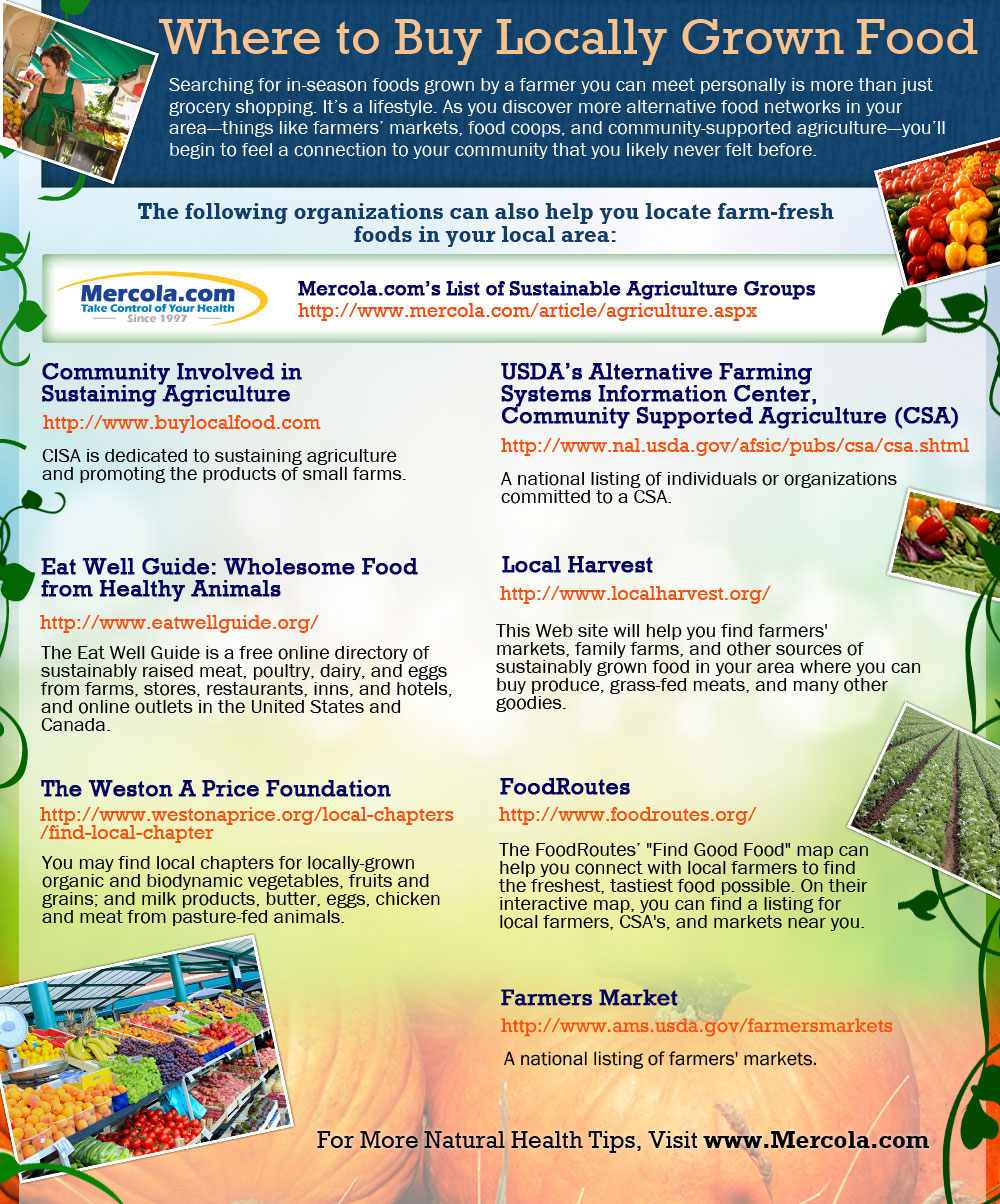
If you reside in the U.S., the following organizations can help you source healthy farm-fresh foods in your local area that have been raised in a humane, sustainable and likely safer manner. You can also print out the flyer below to keep these resources close at hand.
Weston Price Foundation has local chapters in most states, and many of them are connected with buying clubs in which you can easily purchase organic foods, including grass fed raw dairy products like milk and butter. Local Harvest — This Web site will help you find farmers' markets, family farms, and other sources of sustainably grown food in your area where you can buy produce, grass-fed meats, and many other goodies. Farmers' Markets — A national listing of farmers' markets. Eat Well Guide: Wholesome Food from Healthy Animals — The Eat Well Guide is a free online directory of sustainably raised meat, poultry, dairy, and eggs from farms, stores, restaurants, inns, and hotels, and online outlets in the United States and Canada. Community Involved in Sustaining Agriculture (CISA) — CISA is dedicated to sustaining agriculture and promoting the products of small farms. FoodRoutes — The FoodRoutes "Find Good Food" map can help you connect with local farmers to find the freshest, tastiest food possible. On their interactive map, you can find a listing for local farmers, CSAs, and markets near you.
Recipes to the Rescue
Last but certainly not least, unless you're already familiar with cooking from scratch, you likely need to work off a recipe. Fortunately, the internet is a cornucopia in this regard. You can find recipes for just about every type of dish. I highly recommend investing in a good cookbook, but you can also get started by perusing the Recipe Section of my Website, which includes raw, slow-cooked, gluten- and dairy-free recipes.
© Copyright 1997-2016 Dr. Joseph Mercola. All Rights Reserved.
http://articles.mercola.com/sites/articles/archive/2016/01/11/doctors-cooking-skills.aspx