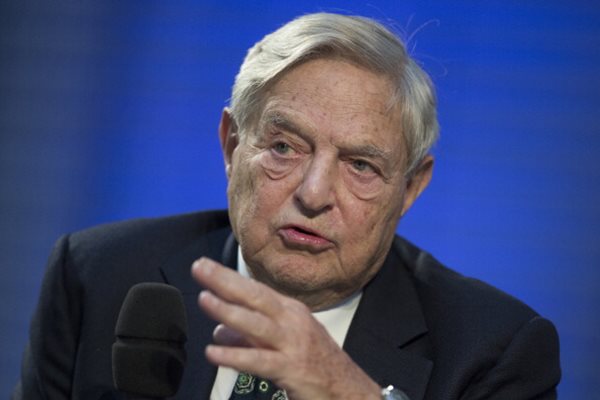
Global markets are facing a crisis and investors need to be very
cautious, billionaire George Soros told an economic forum in Sri
Lanka on Thursday.
China is struggling to find a new growth model and its currency
devaluation is transferring problems to the rest of the world, Soros
said in Colombo. A return to positive interest rates is a challenge
for the developing world, he said, adding that the current
environment has similarities to 2008.
Global currency, stock and commodity markets are under fire in
the first week of the new year, with a sinking yuan adding to
concern about the strength of China’s economy as it shifts away from
investment and manufacturing toward consumption and services. Almost
$2.5 trillion was wiped from the value of global equities this year
through Wednesday, and losses deepened in Asia on Thursday as a
plunge in Chinese equities halted trade for the rest of the day.
“China has a major adjustment problem,” Soros said. “I would say
it amounts to a crisis. When I look at the financial markets there
is a serious challenge which reminds me of the crisis we had in
2008.”
Soros has warned of a 2008-like catastrophe before. On a panel in
Washington in September 2011, he said the Greece-born European debt
crunch was “more serious than the crisis of 2008.”
Soros, whose hedge-fund firm gained about 20 percent a year
on average from 1969 to 2011, has a net worth of about $27.3
billion, according to the Bloomberg Billionaires Index. He began
his career in New York City in the 1950s and gained a reputation
for his investing prowess in 1992 by netting $1 billion with a
bet that the U.K. would be forced to devalue the pound.
Measures of volatility are surging this year. The Chicago
Board Options Exchange Volatility Index, known as the fear gauge
or the VIX, is up 13 percent. The Nikkei Stock Average
Volatility Index, which measures the cost of protection on
Japanese shares, has climbed 43 percent in 2016 and a Merrill
Lynch index of anticipated price swings in Treasury bonds rose
5.7 percent.
China’s Communist Party has pledged to increase the yuan’s
convertibility by 2020 and to gradually dismantle capital
controls. Weakness in the world’s second-largest economy remains
even after the People’s Bank of China has cut interest rates to
record lows and authorities pumped hundreds of billions of
dollars into the economy. Data this week reinforced a sluggish
manufacturing sector.
© Copyright 2015 Bloomberg News. All rights reserved.