Graphene-based sheets make dirty water drinkable simply and cheaply
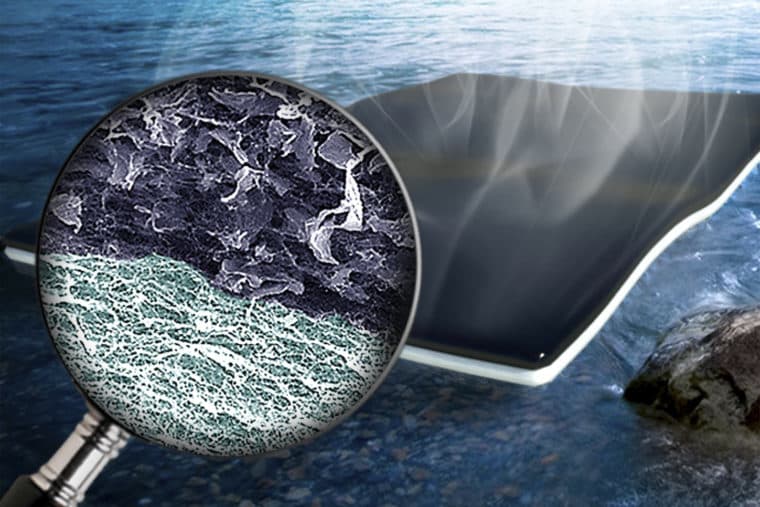
A new system of bi-layered biofoam may provide the means to purify vast bodies of water simply by overlaying them with sheets of this new material (Credit: Washington University at St.Louis)
Engineers at the Washington University in St. Louis (WUSTL) have developed graphene-based biofoam sheets that can be laid on dirty or salty dams and ponds to produce clean drinking water, using the power of the sun. This new technique could be a cheap and simple way to help provide fresh water in countries where large areas of water are contaminated with suspended particles of dirt and other floating matter.
The biofilm is created as a two-layered structure consisting of two nanocellulose layers produced by bacteria. The lower layer contains pristine cellulose, while the top layer also contains graphene oxide, which absorbs sunlight and produces heat. The system works by drawing up water from underneath like a sponge where it then evaporates in the topmost layer, leaving behind any suspended particulates or salts. Fresh water then condenses on the top, where it can be drawn off and used.
"The process is extremely simple," said Srikanth Singamaneni,
associate professor of mechanical engineering and materials at
WUSTL. "The beauty is that the nanoscale cellulose fiber network
produced by bacteria has excellent ability to move the water from
the bulk to the evaporative surface while minimizing the heat coming
down, and the entire thing is produced in one shot."
Whilst this is a novel use of graphene, the researchers claim
that the process used to make their bi-layered biofoam is actually
the most innovative part of the whole experiment. Analogous to the
process an oyster uses to create a pearl, where a small kernel of
material is continually overlaid with layers of a fluid coating that
eventually hardens, the bacteria used in the new material produces
layers of nanocellulose fibers peppered with particles of graphene
oxide flakes.
"While we are culturing the bacteria for the cellulose, we added
the graphene oxide flakes into the medium itself," said Qisheng
Jiang, a graduate student at WUSTL. "The graphene oxide becomes
embedded as the bacteria produces the cellulose. At a certain point
along the process, we stop, remove the medium with the graphene
oxide and reintroduce fresh medium. That produces the next layer of
our foam. The interface is very strong; mechanically, it is quite
robust."
The researchers also claim that the material is exceptionally
light, cheap to make, and can easily be produced in vast quantities.
And, unlike even
exceptionally simple systems designed to do similar things, the
graphene biofoam material is simply laid over a body of water and
does not require systems of pipes or energy to run the water through
for decontamination.
"Cellulose can be produced on a massive scale," said Singamaneni.
"And graphene oxide is extremely cheap — people can produce tons,
truly tons, of it. Both materials going into this are highly
scalable. So one can imagine making huge sheets of the biofoam."
The production system used to create the biofoam also has the
ability to include other nanostructure materials that destroy
bacteria and clean the water more thoroughly, allowing it to produce
safe drinking water from almost any source.
"We hope that for countries where there is ample sunlight, such as India, you'll be able to take some dirty water, evaporate it using our material, and collect fresh water," said Singamaneni.
The results of this research were recently published in the
journal
Advanced Materials.