No silver lining in climate study
AFP•July 11, 2016
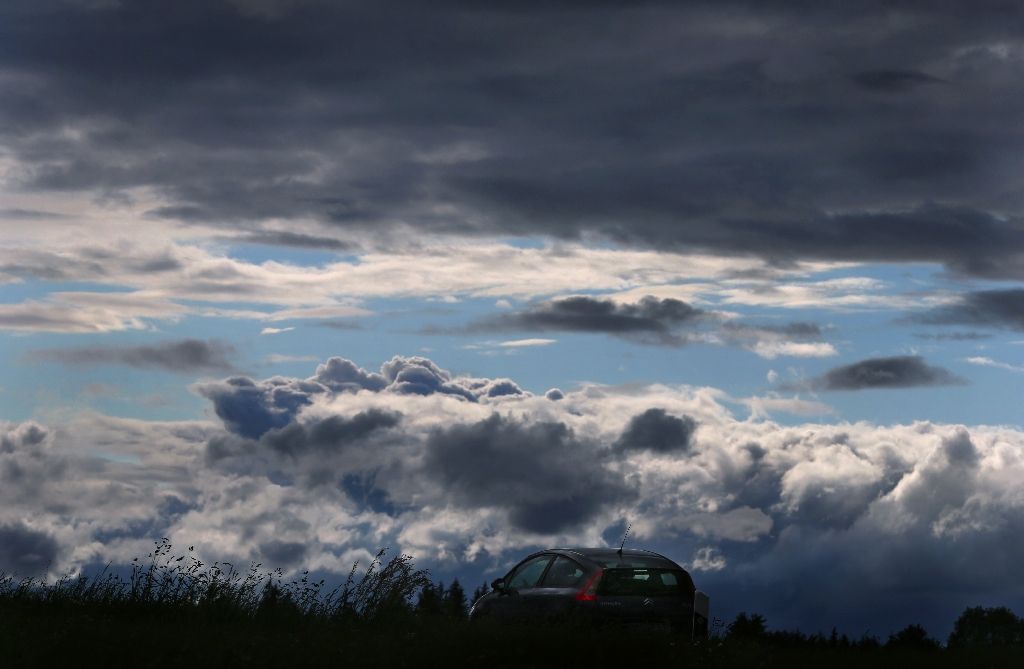
View photos Clouds regulate Earth's temperature by reflecting some solar radiation back into space before it can hit the ground, while also acting as a blanket to limit heat loss from the planet at night (AFP Photo/Karl-Josef Hildenbrand)
Paris (AFP) - Clouds, which act as thermal regulators for Earth, have
altered in character and global distribution due to climate change, and
could in turn make warming worse, a study said Monday.
A trawl of satellite images has revealed reduced cloudiness in Earth's
temperate mid-latitude zones, which lie between the poles and subtropics
in both hemispheres, accompanied by a poleward expansion of the
subtropical dry zones.
The tops of clouds everywhere rose higher, according to data that
stretched over more than two decades from the early 1980s.
"These cloud changes enhance absorption of solar radiation by the Earth
and reduce emission of thermal radiation to space," said a statement
from the Scripps Institution of Oceanography at the University of
California San Diego, which took part in the study.
"This exacerbates global warming caused by increasing greenhouse gas
concentration."
Clouds regulate Earth's temperature by reflecting some solar radiation
back into space before it can hit the ground, while also acting as a
blanket to limit heat loss from the planet at night.
How they are affected by climate change, and how they influence global
warming in return, "has been one of the biggest areas of uncertainty for
scientists attempting to understand current climate and forecast future
trends," said Scripps.
Satellites originally designed to monitor Earth's weather are not stable
enough to reliably track cloud changes over decades.
But the team figured out a way to "correct" the data by removing
confounding factors such as satellite orbit, instrument calibration and
the degradation of sensors.
The record revealed clear changes in cloud distribution, which the team
then compared to a history of Earth-warming greenhouse gas
concentrations in the atmosphere.
"They concluded that the behaviour of clouds they observed is consistent
with a human-caused increase in greenhouse gas concentrations," said the
statement.
There was no similar correlation with other potential influences such as
ozone levels, human-created aerosols, or natural changes in solar
radiation.
Another factor on clouds was two major volcanic eruptions -- the 1982 El
Chichon eruption in Mexico and the 1991 eruption of Mount Pinatubo in
the Philippines, which would have had a net cooling effect on the planet
for a few years at a time.
Volcanoes spew out sunlight-reflecting ash and dust which have a
short-term cooling effect on the planet.
"Barring another volcanic event of this sort, the scientists expect the
cloud trends to continue in the future as the planet continues to warm
due to increasing greenhouse gas concentrations," said the statement.
© Copyright 1999-2016, ClimateArk a Project of EcoInternet
https://www.yahoo.com/news/no-silver-lining-climate-study-191718079.html