Voluntary 'Smart Label' Preempts State and Consumer Rights

Story at-a-glance -
- Senators Roberts and Stabenow have made a deal to create a national labeling standard for GMOs using voluntary “Smart Labels” (so-called QR codes) rather than clear labeling, nullifying Vermont’s law after the fact
- The new legislation also changes the very definition of bioengineering. The newest biotech methods, such as gene editing technology, would be exempt from the disclosure standards
- The bill bars states from enacting GMO-labeling requirements that differ from the national standard, and delays the disclosure requirement another two years. Call to action: Boycott factory farmed foods and GMA “Smart Labels”
By Dr. Mercola
According to the Grocery Manufacturers Association (GMA), 80 percent of the foods on your grocery store's shelves contain genetically modified organisms (GMOs).1 These foods are also most likely to be contaminated with toxic pesticide residues.
Just last month, the Organic Consumers Association (OCA) sued Post Holdings, Inc., for falsely marketing Shredded Wheat cereal as "100 percent natural" and "made with nothing but goodness," after independent testing found it contained glyphosate2 — hardly what health-conscious consumers would expect.
Alas, while Americans are getting savvier when it comes to making healthier food choices, and recent polling shows that 9 out of 10 Americans want to know if their food is genetically engineered (GE),3 big business has successfully usurped power, and politicians have by and large abandoned their constituents.
State and Consumer Rights Under Attack Yet Again
Senate negotiators have now made a deal4 to create a national labeling standard for GMOs using voluntary "Smart Labels" (so-called QR codes5) rather than clear labeling — a deal that goes against the 88 percent of Americans who have said NO to being forced to use a smartphone app to find this important information.
The new bill, S. 2609, would amend the Agricultural Marketing Act of 1946 with a national bioengineered food disclosure standard.6,7 As noted in a June 23 newsletter by the Organic Consumers Association (OCA):
"It's hard to know which is worse. The corporations that profit from poisoning your food and water. Or the politicians who will happily sell you down the river for a few campaign contributions.
Today, our 'leaders' in the U.S. Senate proudly announced that they've 'reached a deal' on a federal GMO labeling bill.
No matter how they spin it — and they will spin it — this 'compromise' is nothing more than a handout to Monsanto, an industry-brokered deal intended to legally sanction the right of corporations to deceive you, the consumer."
Andrew Kimbrell, executive director of the Center for Food Safety (CFS) has called the bill a "blow to to the food movement and America's right to know," adding it is "in many ways worse than prior iterations of the DARK Act that were defeated — it is a blank check for biotech."8
Roberts-Stabenow Deal Tramples Your Rights to Save Biotech Industry
Senate Agriculture Chairman Pat Roberts and ranking Democrat Debbie Stabenow have spent months secretly negotiating this deal which will nullify Vermont's GMO labeling requirement (which officially went into effect July 1) after the fact.
The legislation would also bar any other state from enacting GMO labeling requirements that differ from the national standard, and delays the disclosure requirement another two years — three years for smaller food companies. As reported by AgriPulse:9
"Under the legislation, most food companies would have the option of disclosing GMO ingredients through either a digital smartphone code, the industry's preference, or through an on-package symbol or language that the Agriculture Department would approve.
The code would be accompanied by: 'Scan here for more food information.' Small companies would have the option of putting a phone number or website URL on labels instead of the digital code ...
Roberts said the disclosure system would protect biotech products from being denigrated by opponents. 'We saved agricultural biotechnology,' said Roberts."
Legislation Redefines Bioengineering to Exempt Most GMOs
What's worse, the new legislation changes the very definition of bioengineering. The newest biotech methods, such as gene editing technology, would be exempt from the disclosure standards.
Indeed, the definition of "bioengineered" is so narrow it actually ends up excluding many, if not most, GE products currently on the market. Folks, this is about as crazy as it gets, and it's a double insult to every American who has fought so hard for GMO transparency and honesty.
In an email, Michael Hansen, Ph.D., a senior staff scientist for Consumers Union, notes:10
"Since the mutant EPSPS gene (conferring glyphosate resistance) is found in nature in Agrobacterium sp. strain CP4, and most of the Cry proteins ... are found in Bacillus thuringiensis, a narrow reading of this definition would not include the RoundUp Ready crops nor the vast bulk of Bt crops.
It would only include those crops that have hybrid Cry proteins (which don't occur in nature).
The bill realizes that this definition of 'bioengineering' is significantly different than the definition that Food and Drug Administration (FDA) uses ... since there is a section that says the definition only applies to this bill ...
Another loophole is that the U.S. Department of Agriculture (USDA) will get to suggest the level of GE content that will trigger labeling, e.g. set a tolerance or threshold ...
Indeed, the bill seems to realize that the various exemptions are extensive, since another part of the bill says that just because a food is not required to be labeled as 'bioengineered' it cannot be labeled as 'non-GMO' ... So, this means that the non-GMO project labels will still exist.'"
Even the U.S. Food and Drug Administration (FDA) has criticized the bill. In its technical comments, the FDA notes that the way GMOs are redefined, it may be difficult for any GMO to qualify for labeling!
Moreover, the bill gives the USDA sole authority over GMO claims on food, which would normally fall under the FDA's jurisdiction. Unfortunately, it appears this bill is more or less a done deal already, in large part due to the Organic Trade Association11 (OTA) selling out.
OTA, a Mere Pawn of the GMA?
Sadly, it appears the OTA is little more than a pawn of the GMA, as big junk food have gobbled up smaller organic companies. The OTA is using the same inaccurate talking points as Big Food when talking about how good this bill is, when in reality the OTA has sold out and abandoned the organic food movement.
According to the OTA,12 the Roberts-Stabenow bill "covers thousands more products than Vermont's GMO labeling law and other state initiatives." This simply isn't true. The reality is that this bill would label FEWER products, as it doesn't cover all the GMOs covered by Vermont's law and other labeling initiatives.
As just discussed, most GMOs on the market — as much as 99 percent — could potentially be exempt from labeling under this bill! Moreover, since there's no enforcement, the labeling requirements are hardly more than a voluntary suggestion.
How did the OTA become so misguided? In short, large multinational food companies have bought up many popular organic brands and have effectively infiltrated and in large part taken over the OTA.13
The companies that convinced the OTA to support the DARK Act and its current iteration are non-organic junk food brands that happen to own organic brands. Their main concern is NOT protecting organics however. They're exploiting the organic market niche, but the real money is still in selling their inexpensive GMO wares.
Who really owns the organic brands you trust and love? Check out the Cornucopia Institute's "Who Owns Organic" graphic.14 You may be surprised.
Take J.M. Smuckers Company, for example. With annual revenue of about $8 billion, Smuckers is best known for their sugary condiments and unhealthy "food-like substances" sold under the Dunkin' Donuts, Pillsbury, Jif and Crisco brands.
Alas, Smuckers also owns RW Knudsen and Santa Cruz juices, and Smuckers' employee Kim Dietz is on the OTA Board of Directors.15
If you think this makes Smuckers a pro-organic company, you'd be wrong. Smuckers spent $640,000 to oppose GMO laws in Oregon and Colorado, and $550,000 to oppose labeling in California.
In total, Smuckers has spent $1.19 million to defeat GMO labeling. They may have employees on the OTA board — and when it lobbies Congress, Smuckers can represent itself as an OTA member16 — but their corporate behavior is anything but pro-organic.
It lobbied to pass the DARK Act, using a firm that also represents the GMA,17 and evidence suggests Smuckers has manipulated the OTA for years. Not only does Smuckers use GE ingredients in their foods, according to the OCA,18 "the President of the Board of Directors of the OTA, Julia Sabin, VP/GM of Smucker Natural individually profits from Smucker selling GE foods."
What OTA and 'Big Food' Members Gain by Undermining Transparency
The sad fact is, the OTA does NOT speak for a majority of the truly organic food producers in the U.S. and does not represent the organic community's interests. What's worse, it appears the OTA purposely undermined transparency in order to protect the organic niche.
Mandatory disclosure of GMOs would actually eliminate a key advantage that organic conveys. As I've repeatedly mentioned, one of the key reasons for eating USDA 100 percent organic is to avoid unlabeled GMOs. If GMOs must be disclosed, Big Organic loses that selling point. So, crazy as it may seem, anti-transparency actually benefits organics. Moreover, the bill would also allow organic companies to make non-GMO claims on their products.
Loopholes Abound in Roberts-Stabenow 'Smart Label' Deal
Other details of the agreement include the following, which offer the food industry plenty of leeway when it comes to accurately and honestly disclosing GMOs:19
- "Very small" food manufacturers and all restaurants would be exempt from GMO disclosure rules
- Meat and dairy products from animals fed with GMO grains would be exempt from any disclosure requirement
- Food products where meat, poultry or egg is the main ingredient, such as pizza for example, would be exempt even if it contains GMOs like high-fructose corn syrup from GE corn or, say, GE soybean or canola oil
- The USDA would have no authority to require recalls of products that don't comply with the labeling requirements
- There would be no federal penalties for violations, although states would be allowed to impose fines for violations under state consumer protection rules
People Don't Use QR Codes, Which Is Exactly Why Industry Wants Them
QR stands for Quick Response, and the code can be scanned and read by smartphones and other QR readers.20 The code brings you to a product website that provides various details about the product. But these so-called "Smart Labels" hardly improve access to information.
A mere 16 percent of poll respondents say they've ever scanned a QR code to get information about a product,21,22 and to expect shoppers to scan and read an entire website for each and every product in their cart in order to determine whether or not they contain GMOs is beyond ludicrous.
Besides the fact that it's simply not a workable method, it's just plain wrong since everyone has a right to know what's in the food. You shouldn't have to own a smartphone to obtain this information. As previously noted by Lisa Archer, food and technology program director at Friends of the Earth:
"GMO labeling via QR code technology is unworkable, threatens privacy and is discriminatory since more than a third of Americans, many of which are low-income or live in rural areas with poor internet access, don't own smartphones."
Jean Halloran, director of food policy initiatives for Consumers Union, the policy and advocacy division of Consumer Reports, issued a similar statement in response to the Roberts-Stabenow bill:23
"This deal is unacceptable to the 9 out of 10 Americans who support mandatory GMO labeling. Consumers deserve to know what's in their food and to be able to make informed decisions. They have been clear that they want straightforward GMO labels that they can read and understand at a quick glance when shopping.
This law would instead allow GMO disclosure to be done through scannable codes, phone numbers or websites — making it difficult, if not impossible for the average consumer to find out what they want to know as they try to decide which kind of cereal or snack to buy.
While we appreciate efforts by Senator Stabenow and others to seek a better bill than the one passed by the House last summer, this deal does not meet consumer needs. QR codes, 1-800 numbers or websites aren't a solution. The new Senate bill is just another way to allow companies to keep consumers in the dark — especially the one-third of Americans who don't own a smartphone and those in rural areas without reliable broadband service."
Vow to Boycott Foods Bearing QR Codes
It should be crystal clear to everyone that by being time-consuming and cumbersome (and in some cases impossible) to use, food makers know the QR codes will help them hide the presence of GMOs in their products, and this is precisely why I propose a new strategic campaign: boycott all products bearing QR codes. The proposed legislation would allow companies to divulge the presence of GMOs in their product using one of three ways:24
- Text on the package (although the exact and now-familiar terms "GMO," "genetically modified" or "biotechnology" are not necessarily going to be required. The USDA would determine the language)
- A symbol (to be determined by the USDA)
- A QR code (or for smaller food companies, a website address or 1-800 number)
If a company refuses to clearly label their product as containing GMOs via text or symbol, and opts for a Smart Label instead, I believe it's safe to assume it's because it has something to hide. They're just trying to prevent as many people as possible from finding out the truth right away by not putting clear text or a GMO symbol on their product.
Why play along? If they want to be coy and opaque, strike back where it hurts — their bottom line. Don't waste valuable time searching for the information they want to hide. Instead, just don't buy the product!
Food Industry Group Has ILLEGALLY Lobbied to Remove Consumer and State Rights
The GMA is an industry group made up of a conglomeration of the biggest junk food producers on the planet, and this organization, which I dubbed the "Most Evil Organization on the Planet" in 2014, is a key player in this GMO labeling drama. The companies represented by the GMA are largely responsible for the massive obesity epidemic that spreads sickness and disease, yet they refuse to take responsibility and amend their ways.
Instead, they've spent hundreds of millions of dollars to deny your right to know important facts about the food you eat and remove state rights, while further corrupting Congress through massive lobbying "donations."25
A little known fact is that the GMA actually owns the "Smart Label" trademark that Congress has accepted as a so-called "compromise" to on-package GMO labeling, and that's another reason why I believe the Smart Label mark is the mark of those with something to hide.26
The GMA's 300-plus members include chemical technology companies, GE seed and food and beverage companies. Monsanto, Dow, Coca-Cola and General Mills are just some of the heavy-hitters in this powerful industry group, which has showed no qualms about doing whatever it takes to protect the interest of its members.
This includes deceptive and outright illegal tactics to take away consumer and state rights. For example, in March, the GMA was found GUILTY of perpetrating an $11 million money laundering scheme during Washington's 2013 GMO labeling initiative. The aim was to hide the identities of the members contributing to the campaign, in order to shield them from consumer backlash.27
How can the GMA and its members possibly be trusted to do the right thing? Let's not forget that doing the right thing is absolutely critical here, because we're talking about companies that (are supposed to) provide nourishing sustenance to you and your family. If honesty is important in any business, it would surely be the food business!
Yet in just three years, from 2013 through 2015, the food industry spent nearly $200 million on anti-labeling campaigns. If you bought any processed food at all in the last few years, you have undoubtedly supported their efforts to pull the wool over your eyes because the list of traitor companies is long indeed, and contains many of the most widely bought brands in the U.S. Isn't it time to stop paying these companies to lie to you and deceive you?
Encourage Your Favorite Brands to Shun 'GMA's Verified Ring of Deception'
My suggestion? When you see the QR code or so-called Smart Label on a food product, pass it by. Products bearing the GMA's Smart Label mark are in all likelihood filled with pesticides and/or GMO ingredients. Don't waste your time searching through their website, which may or may not contain the information you're looking for. If they insist on wasting your time and making your shopping difficult, why reward them with a purchase?
If you think this sounds like a challenge, I beg you to reconsider and to take the wide view. What's your health, and the health of your family, worth to you? Remember, each and every time you shop, you actively support one type of food system or another. Will you financially support a corrupt, toxic and unsustainable food system, or a healthy, regenerative one? There are many options available besides big-brand processed foods that are part of the "GMA's verified ring of deception." You can:
- Shop at local farms and farmers markets
- Only buy products marked either "USDA 100 percent Organic" (which by law cannot contain GMOs), "100 percent Grass-Fed," or "Non-GMO Verified"
- If you have a smartphone and you don't mind using it, download the OCA's Buycott app to quickly and easily identify the thousands of proprietary brands belonging to GMA members, so you can avoid them, as well as identify the names of ethical brands that deserve your patronage
Last but not least, encourage good companies to reject QR codes and to be transparent and clear with their labeling. This will eventually ensure that all GMO foods can easily be identified by the GMA's "verified ring of deception" mark that is the Smart Label.
Campbell's, Mars, Kellogg's, ConAgra and General Mills all vowed to voluntarily comply with Vermont's GMO labeling law by labeling all of their foods sold across the U.S. Will their plans change if the current "compromise" gets passed by the Senate? That remains to be seen, but if you like these companies, I would encourage you to reach out to them and ask them to remain steadfast in their promise.
What You Need to Know About GMOs
Genetically modified organisms (GMOs), or genetically “engineered” (GE) foods, are live organisms whose genetic components have been artificially manipulated in a laboratory setting through creating unstable combinations of plant, animal, bacteria and even viral genes that do not occur in nature or through traditional crossbreeding methods.
GMO proponents claim that genetic engineering is “safe and beneficial,” and that it advances the agricultural industry. They also say that GMOs help ensure the global food supply and sustainability. But is there any truth to these claims? I believe not. For years, I've stated the belief that GMOs pose one of the greatest threats to life on the planet. Genetic engineering is NOT the safe and beneficial technology that it is touted to be.
The FDA cleared the way for GE (Genetically Engineered) Atlantic salmon to be farmed for human consumption. Thanks to added language in the federal spending bill, the product will require special labeling so at least consumers will have the ability to identify the GE salmon in stores. However, it's imperative ALL GE foods be labeled, which is currently still being denied.
The FDA is threatening the existence of our food supply. We have to start taking action now. I urge you to share this article with friends and family. If we act together, we can make a difference and put an end to the absurdity.
Boycott Smart Labels Today
When you see the QR code or so-called Smart Label on a food product, pass it by. Products bearing the Grocery Manufacturer’s Association’s (GMA) Smart Label mark are in all likelihood filled with pesticides and/or GMO ingredients.
The GMA’s 300-plus members include chemical technology companies, GE seed and food and beverage companies. Monsanto, Dow and Coca-Cola are just some of the heavy-hitters in this powerful industry group, which has showed no qualms about doing whatever it takes to protect the interest of its members.
Don’t waste your time searching through their website, which may or may not contain the information you’re looking for. If they insist on wasting your time and making your shopping difficult, why reward them with a purchase? A little known fact is that the GMA actually owns the "Smart Label" trademark that Congress has accepted as a so-called “compromise” to on-package GMO labeling, and that’s another reason why I believe the Smart Label mark is the mark of those with something to hide such as Monsanto.
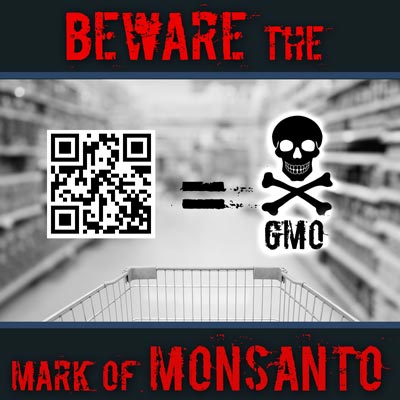
Will you financially support a corrupt, toxic and unsustainable food system, or a healthy, regenerative one? There are many options available besides big-brand processed foods that are part of the “GMA’s verified ring of deception.” You can:
- Shop at local farms and farmers markets
- Only buy products marked either “USDA 100 percent Organic” (which by law cannot contain GMOs), “100 percent Grass-Fed,” or “Non-GMO Verified”
- If you have a smartphone and you don’t mind using it, download the OCA’s Buycott app to quickly and easily identify the thousands of proprietary brands belonging to GMA members, so you can avoid them, as well as identify the names of ethical brands that deserve your patronage
Last but not least, encourage good companies to reject QR codes and to be transparent and clear with their labeling. This will eventually ensure that all GMO foods can easily be identified by the GMA’s “verified ring of deception” mark that is the Smart Label.
Campbell’s, Mars, Kellogg’s, ConAgra and General Mills all vowed to voluntarily comply with Vermont's GMO labeling law by labeling all of their foods sold across the U.S. Will their plans change if the current “compromise” gets passed by the Senate? That remains to be seen, but if you like these companies, I would encourage you to reach out to them and ask them to remain steadfast in their promise.
Non-GMO Food Resources by Country
If you are searching for non-GMO foods, here is a list of trusted sites you can visit.
- Organic Food Directory (Australia)
- Eat Wild (Canada)
- Organic Explorer (New Zealand)
- Eat Well Guide (United States & Canada)
- Farm Match (United States)
- Local Harvest (United States)
- Weston A. Price Foundation (United States)
© Copyright 1997-2016 Dr. Joseph Mercola. All Rights Reserved.
http://articles.mercola.com/sites/articles/archive/2016/07/05/gmo-smart-labels.aspx