The universe is an unfathomably vast place, but so far it feels
very empty. Scientists have been looking for evidence of
extraterrestrial life for a few decades, and nothing has presented
itself. The sheer mathematical probability would seem to make
extraterrestrial
life a certainty, although how can we know when E.T. comes
calling? Researchers from McMaster University in Ontario have put
forth an interesting proposal: We need to make sure they can see us
in the first place.
This all goes back to the
Fermi Paradox, a thought experiment proposed by noted physicist
Enrico Fermi. It holds that if life is common throughout the
universe, we should have already been contacted by intelligent
extraterrestrials. So, where is everybody? René Heller and Ralph
Pudritz from McMaster University aren’t presuming to have an answer
to that, but they think our best chance to pick up on a signal from
alien life is to make sure they know we’re here by assuming they
would use the same planet-hunting techniques that we do.
The light from distant stars blots out the comparable faint light
from exoplanets,
so there are two main ways astronomers infer the presence of these
planets. The older method is to watch for counter movements in a
star caused by massive planets orbiting it. More recently, the
transit method has resulted in the identification of hundreds of
worlds outside our solar system. Astronomers using the transit
method simply watch for small dips in light output from a star that
indicate a planet has passed in front of it. Collecting that light
can even allow us to estimate things like temperature and
atmospheric composition.
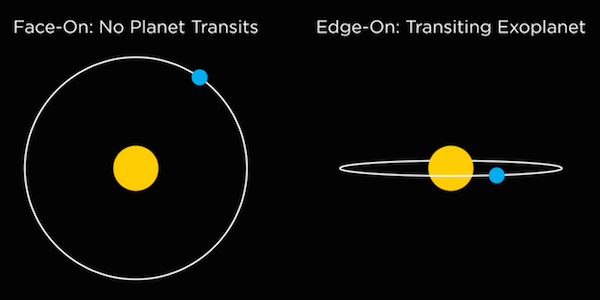
There is one major limitation of the transit method, and it’s the
crux of this new proposal. It only works when you can see a solar
system edge-on such that its orbital plane is overlapping the star.
If we assume that other civilizations have been using the same
approach to spotting exoplanets, then
only the ones in Earth’s “transit zone” will have spotted us. If
we’re going to get a call from beyond the stars, that narrow band of
sky could be where it comes from — that’s where the radio telescopes
should be pointed. We can’t know how an alien civilization would
search for other planets, but they would be contending with the same
laws of physics that we are.
Heller and Pudritz say that we should focus our detection efforts
on the transit zone in increase our odds of detecting an alien
signal. There are over 100,000 stars in the transit zone, each of
which might have habitable planets around it. There might even be a
signal from one of these worlds directed at Earth already, but we
simply haven’t noticed it yet.